
Key takeaways
- A monthly report full of totals tells a client nothing they can act on. The number that means something is the difference since last month.
- The most persuasive line in any retainer report is the comparison. You gained six reviews, your competitor gained two. That one sentence is what the retainer buys.
- Track the competitors the client names, not the ones you would pick. They are not the same list and only one of them matters to the person reading.
- Local rankings pulled without geo targeting are fiction, and a report built on fiction is worse than no report because it shows movement that never happened.
- A flat month gets reported as a flat month. Clients forgive a quiet month. They do not forgive finding out about it themselves.
Every agency eventually builds a client dashboard, and almost nobody logs into it. We built the reporting half of our monthly retainer around that fact instead of around the dashboard.
The observation behind it is not complicated. Churn on a local retainer is almost always the same failure, and it is not that the work did not happen. It is that the work happened and the client never saw it. So the reporting job is not to display data. It is to answer one question in a form somebody reads on a phone between appointments: what changed, and was any of it us.
The snapshot is not the report
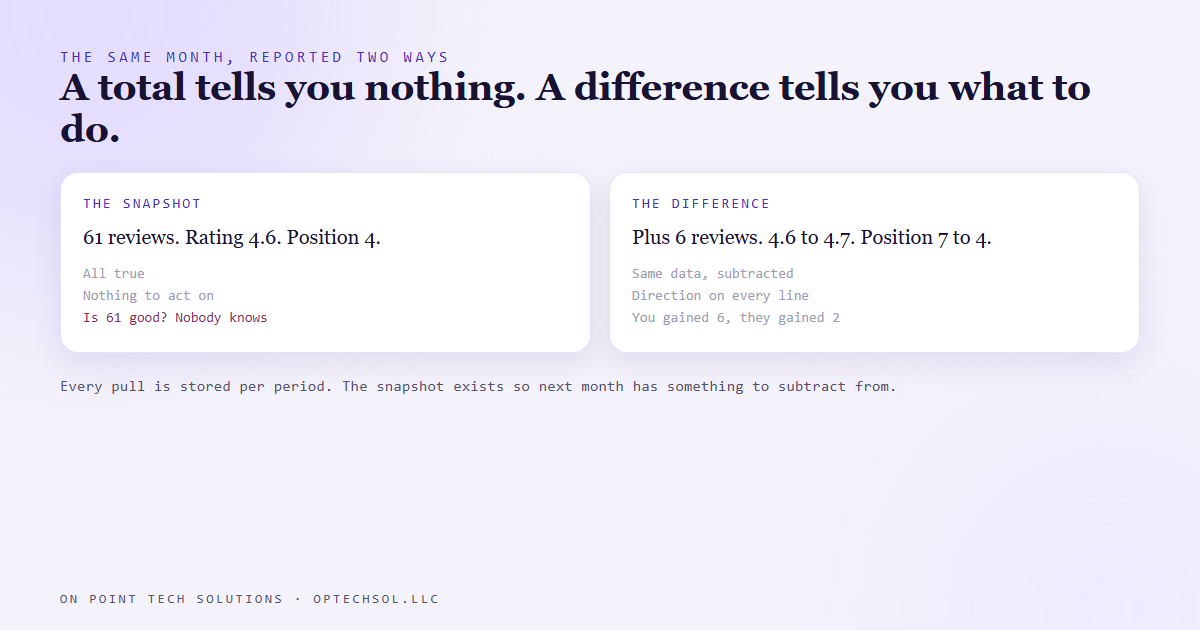
The first version of anything like this shows current state. Here is your review count. Here is where you rank. Here is your rating. All true, all useless, because a number with no comparison in it is decoration.
Nobody knows whether 61 reviews is good. They know whether six new ones this month is good. Nobody can act on ranking at position four. They can act on position seven moving to position four, and they can definitely act on position four sliding to position nine.
So every pull gets stored per period and the report is the diff. Keyword positions as old to new with the direction on the end. Review count as the number added. Rating as the movement rather than the value. Site health as the change in the audit score, plus anything new that broke. The snapshot exists only so the next month has something to subtract from.
The line that does the work
One row carries more weight than the rest of the report put together, and it is the competitor comparison on reviews.
You gained six reviews this month. The shop two streets over gained two. That is a sentence a business owner understands instantly, and it is the clearest statement of what a retainer is actually producing.
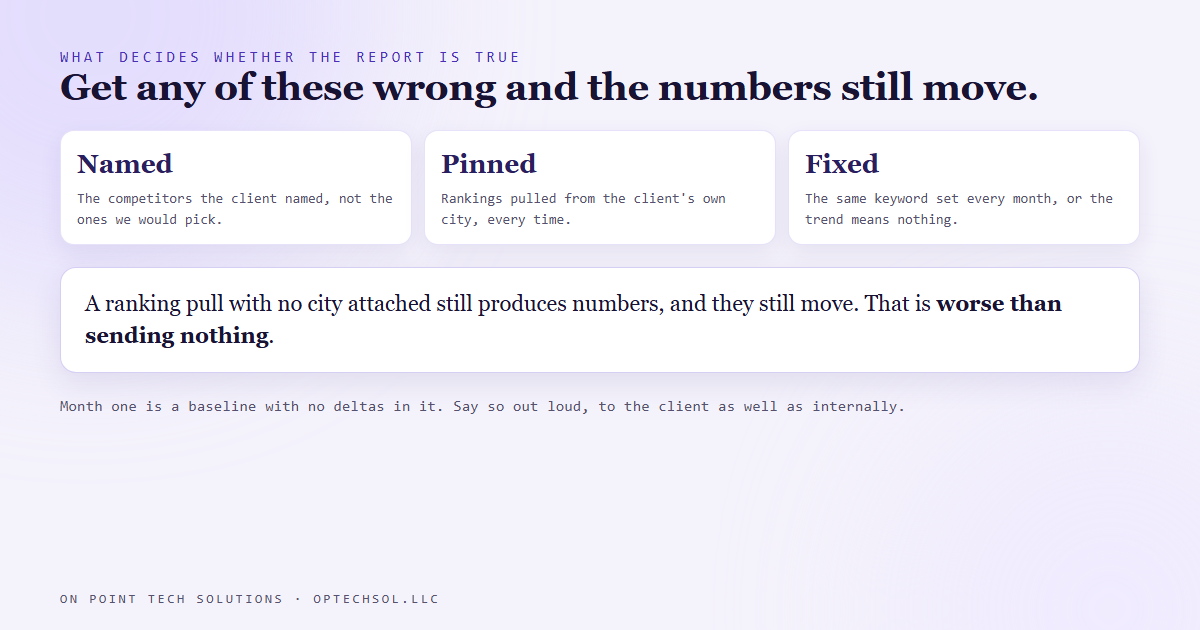
Which makes the choice of competitor the most important input in the process. The competitors we would pick from a map are the ones that look similar to us. The competitors the client names are the ones they are actually losing sleep over, and those two lists overlap less than you would think. So we ask once, at onboarding, and store the answer. Two or three names, in their words.
Same rule for keywords. Five to ten local terms, and the same set every single month, because the moment the list changes the trend line stops meaning anything. A report that quietly swaps in easier keywords when the hard ones go badly is not a report.
The mistakes that make a report lie
Two of these are worth more than the rest of this article if you are building something similar.
The first is geography. Local search results are different depending on where the search comes from, so a ranking pull that does not pin itself to the client's actual city is not measuring their market. It is measuring some average. The dangerous part is that it still produces numbers, and those numbers still move month to month, so you end up reporting movement that never happened in the real world. That is worse than sending nothing at all, because now the client is making decisions on it.
The second is the first month. There is no delta on a first run, because there is nothing to subtract from. Month one is a baseline and it has to be labelled as one, out loud, to the client as well as internally. Otherwise the first report reads as a report with the numbers missing and the relationship starts on the back foot.
The honest month
Here is the version most agencies never build, and it is the one that keeps clients.
Some months nothing much moves. Rankings hold, reviews trickle, the competitor did nothing interesting either. The temptation is to pad it. Add a chart. Report a vanity number.
Ours says it was a quiet month, names the one thing that did move, and says what is being done differently next month. That is the whole entry. A client can hear that. What a client cannot forgive is discovering a flat quarter on their own, three reports after it started, and realising every one of those reports was written to obscure it.
The work section follows the same rule. It lists real work only, pulled from the actual task history rather than from a template of what we usually do.
What this means for your business
If you pay somebody monthly for marketing, ask them for the diff. Not a dashboard login, not a PDF of totals, a short message that says what changed since last time and how much of it was them. If that is hard for them to produce, it is worth knowing why.
If you run the marketing yourself, you can build a rough version this week with nothing but a spreadsheet and a calendar reminder. Write down your review count, your rating, your five most important search terms and where you sit on each, plus the same numbers for two competitors. Do it again in thirty days. The second month is when it becomes useful, and it stays useful after that.
Either way the standard is the same, and it is a fair thing to expect from any GHL consultant Bay Area businesses put on retainer: the report says what moved, it compares you to somebody real, and it tells the truth in a quiet month.
Want this built for you
We build websites, CRM systems and automation for small businesses, and we report on them in plain language every month. Want to build this yourself? Join the On Point Tech Academy. It's free, and we build live every Tuesday and Thursday.
The On Point Tech Academy costs nothing and never asks for a card. We build live every Tuesday and Thursday, 12:30 to 1:30 PT.
Join the Academy free ← Back to all Field Notes