Key takeaways
- We ran full teardowns of two competitors to find angles to attack. We found them, and they were not the useful part.
- The useful part was a list of questions their websites answered plainly and ours did not answer anywhere.
- Three holes came out of it: no compliance story, a price that lived in one place and drifted everywhere else, and no standing answer to "where can I see this before I buy".
- Writing down a competitor's whole offer forces you to write down yours in the same shape, which is the first time most businesses ever do that.
- The output that changed our work was not the list of their weaknesses. It was the list of our silences.
We spent a day on two competitors in a vertical we build for. Not a glance at their homepage. Every page mirrored, every training video transcribed, the pricing tables copied out, the product mechanics written up screen by screen.
The goal was ordinary competitive research. Find what they are weak at, aim there. We got that. Their pricing gets painful for a whole team, their interfaces are dated, one of them has no real story about AI at all. Real openings, all of them still true.
None of that is what the exercise was worth.
The section nobody plans for
Both write ups ended up with a section neither was supposed to have. Call it patterns worth copying. Things these companies did that we had simply not thought about.
Once you have written that section for a competitor, you have accidentally written an audit of yourself. Every line in it is a thing they answered and you did not.
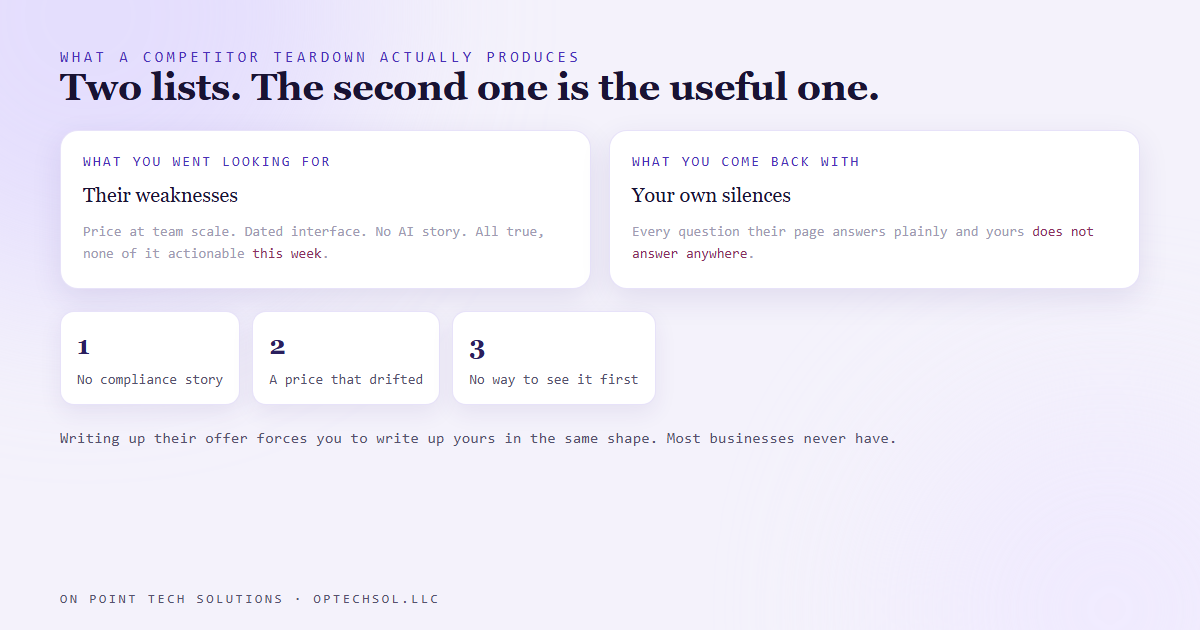
Three of those lines mattered enough to change what we build.
Hole one: no compliance story anywhere
Both competitors treat compliance as a selling point rather than a chore. Every report a user generates is recorded automatically, and that record is the retention feature: leaving means losing your paper trail. One of them screens for suitability problems and ranks them by severity before the application goes out, so the tool is positioned as saving deals rather than slowing them.
We had none of that written down. Not missing from the product, missing from the conversation. Nobody visiting us could tell what we did about it, because we had never said.
The reframe was the valuable bit. Compliance as deal saving instead of deal slowing is a positioning choice available to any regulated business, and it costs nothing to make. Compliance gates went into our build scope from day one after that, not as a phase two.
Hole two: our price was consistent in exactly one place
We could tabulate a competitor's entire price list off their own page in ten minutes. Both tiers, monthly and annual, what the higher tier adds, contract terms.
Then we tried to do that to ourselves and found something uncomfortable. Our real number was correct in the one document we treat as canon, and copies of it had drifted everywhere else. A live assistant was quoting a rate card we had retired. A sales deck was selling a monthly figure attached to a different scope.
Both had been wrong for about three weeks. Both were caught by someone happening to notice.
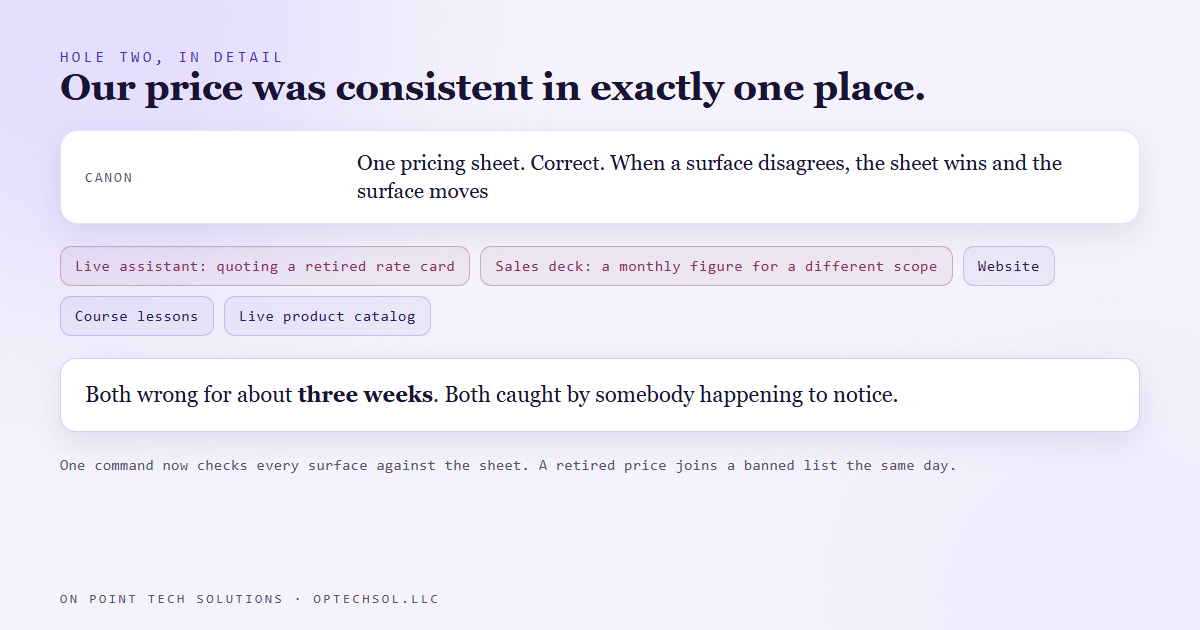
The lesson is not "be careful with prices". Copies of a price list guarantee drift, because the copies are the point of failure and nobody remembers all of them. So we stopped relying on remembering. One sheet is canon, and one command now checks every surface against it: the website, the assistants, the decks, the course lessons, the live product catalog. When a surface disagrees, the sheet wins and the surface moves. When a price is retired, it goes on a banned list the same day so it can never reappear.
For any Go High Level Bay Area business running more than a couple of channels, this is the single highest value hour you can spend. Count the places your price appears. It is always more than you think, and one of them is always old.
Hole three: no standing answer to "can I see it first"
One competitor runs a free session the same night every week, on the same platform, with a registration page and a replay page for people who missed it. That is it. It is not clever. It is just always there.
We had no equivalent. Anyone curious about how we work had exactly one path, which was to book a sales call. That is a big ask for someone who is still deciding whether you are worth an hour.
What made this land was seeing how mundane their version is. No production value, no funnel wizardry. A recurring slot, publicly listed, and a place to watch it afterwards. We now run our own weekly live sessions, and the honest reason we run them is that a teardown of somebody else made the gap visible.
How to run this on yourself
You do not need a research budget. Pick the competitor your prospects mention most and write up their offer as if you had to sell it. Their pricing, their guarantee, their onboarding, what happens in week one, how someone sees it before buying, what they say about the scary parts of your industry.
Then read your own website answering the same questions and mark every one you cannot answer from the page. That list is the output. It will be shorter than you expect and more actionable than anything you would have written in a planning session, because it came from a real page a real buyer compared you against.
One warning. Do not let this turn into copying. Two of the three holes above we filled our own way, and the third we filled with a format so plain it belongs to nobody. The value is in noticing the question, not in mimicking their answer.
What this means for your business
Competitive research has a reputation for being busywork, and when it produces a slide about someone else's weaknesses it usually is. The version that pays is the one that audits you first, because you cannot act on their weaknesses this week and you can absolutely publish your price this week.
Want this built for you
We build the systems behind the offer: the site, the automation, the follow up, and the boring checks that keep them all saying the same thing. Want to build this yourself? Join the On Point Tech Academy. It's free, and we build live every Tuesday and Thursday.
The On Point Tech Academy costs nothing and never asks for a card. We build live every Tuesday and Thursday, 12:30 to 1:30 PT.
Join the Academy free ← Back to all Field Notes