
Key takeaways
- Every outbound email and text we send to a customer goes through the CRM. No exceptions, including the ones that would be faster from a personal inbox.
- A message sent from a personal client is invisible to everybody else and to your future self. It never lands on the contact's record, so the next person reading that contact has no idea it happened.
- The rule forces a contact record to exist before a conversation can. That turns out to be the feature, not the friction.
- Reading is still allowed everywhere. The rule is about being the origin of a message, not about where you search for one.
- The status a platform hands back after an email says nothing at all, and everybody reads it as delivered. Accepted is not delivered, and we proved it the expensive way.
This is a short rule with a long tail. Every outbound message to a customer leaves from the CRM. Not from a personal inbox, not from a phone, not from whichever tool happened to be open.
It was set after watching a draft get built in an email client for something the CRM could have sent in one call. The instruction was one word long. Always.
Why the rule has no exceptions
The reason is not tidiness, and it is not compliance. It is that a message sent from anywhere else does not exist.
Picture the next person who opens that customer's record. A teammate, you in three months, an assistant preparing for a call. They see every message that went through the CRM, in order, with dates. They do not see the one you fired off from your phone at nine at night, because nothing anywhere knows it happened.
So they follow up on something already answered. Or they contradict a promise nobody logged. Or they ask a question the customer answered a week ago, which is the single fastest way to look like a business that is not paying attention.
The record is the entire point. A message outside it is not a faster version of the same thing, it is a different thing that leaves no trace.
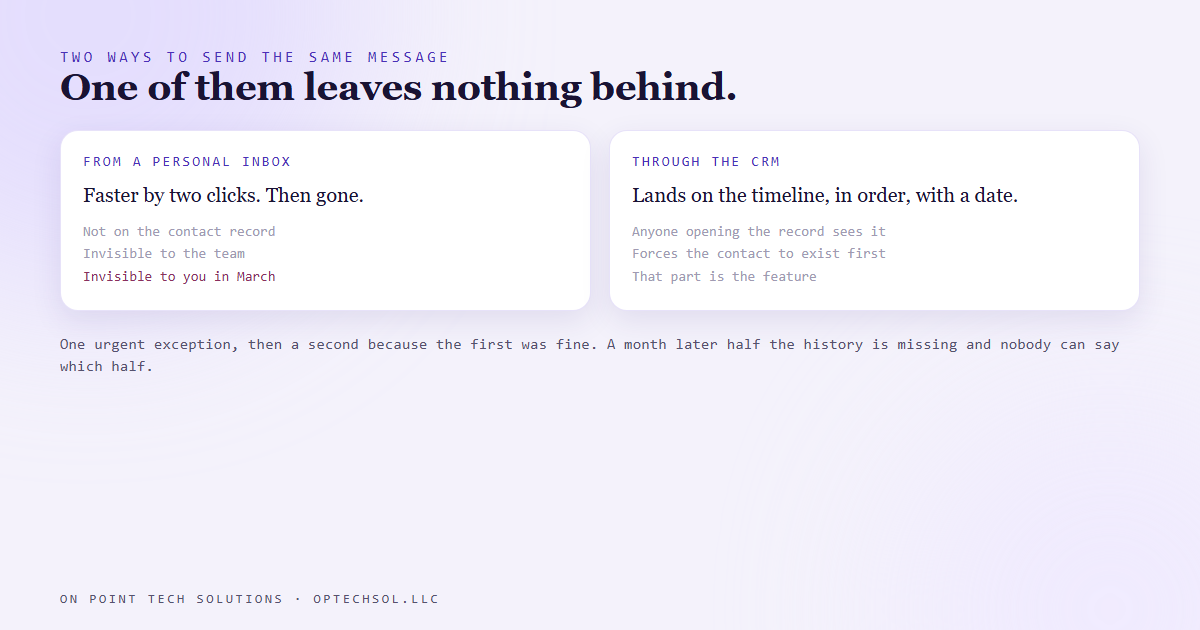
An exception is also how a rule like this dies. Not dramatically. One urgent message goes out from a phone because the CRM was two clicks further away, then a second one because the first was fine, and within a month half the history is missing and nobody can say which half.
The friction is the feature
There is one consequence people trip over immediately. You cannot message somebody who is not in the CRM. There is no field to type a stranger's address into. The system keys off the contact record, so no record means no message.
That feels like an obstacle for about a day, and then it stops being one. Creating the contact first is not a step before the work, it is the work. The tracking you wanted is the record you just made. Skipping it would have meant sending a message into a void and remembering it yourself, which is the thing the rule exists to prevent.
Worth being clear about the boundary, though. This is a rule about sending, not about reading. Search your email, pull context out of it, triage it, quote from it. All fine and all useful. The line is that your inbox is not allowed to be the origin of an outbound message to a customer.
The status field that says nothing
Now the part that cost us the most, and the part most likely to be true in whatever system you are using.
When we hand an email to the CRM, the response comes back with an identifier. It looks exactly like a receipt. It is not one. It means the platform accepted the message, and nothing beyond that.
We proved it in the worst possible way. A real message to a real person was accepted, appeared on the contact's timeline at a specific second, and never reached the mailbox. Not the inbox, not spam, not the trash, checked an hour later. The address was valid and the contact was not blocked. Somewhere between accepted and delivered it stopped, and nothing ever said so.
Two smaller findings from the same test, both worth knowing. The status field on the message is empty rather than failed, which is not evidence in either direction and gets read as good news. And the identifier handed back in the response does not match the one the conversation lists a second later, so you cannot even look your own send back up by the receipt you were given.
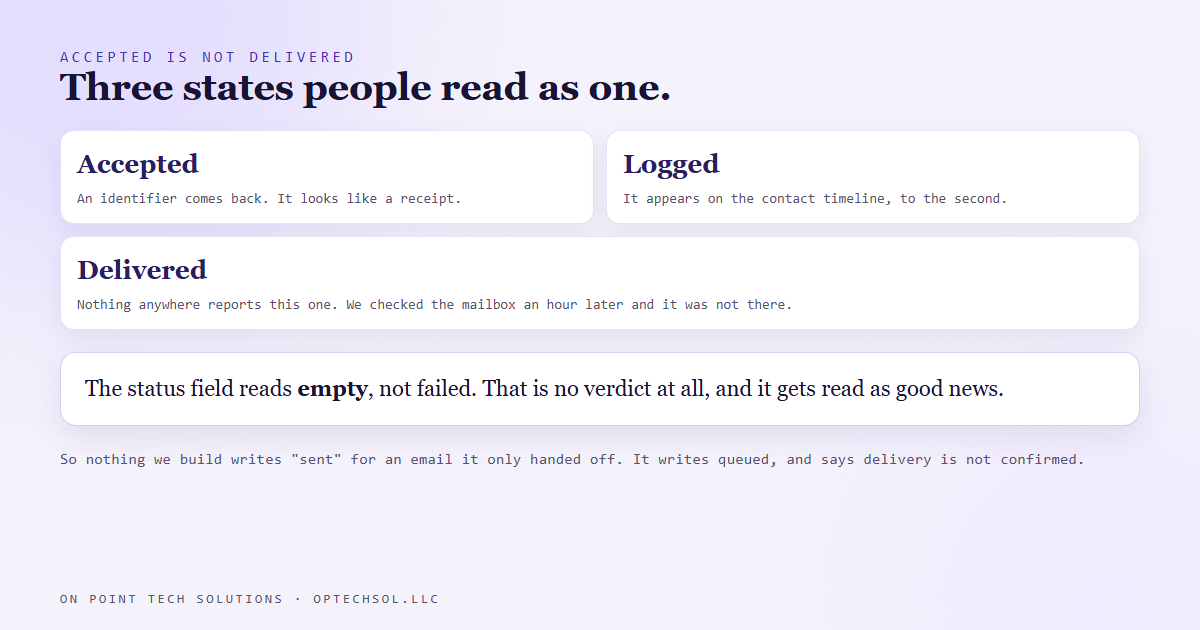
So the language changed everywhere. Nothing we build writes "sent" for an email it only handed off. It writes queued, and it says the platform accepted it and that delivery is not confirmed. Every status stamp, every log line, every note.
That sounds pedantic until you sit with what the alternative does. Over claiming here is worse than the outage itself, because it makes you believe a client read something that never arrived. You stop chasing. You reference it on the next call. The customer has no idea what you are talking about, and the damage lands on the relationship rather than on the software.
What this means for your business
Three things, and none of them need new software.
Pick one place where customer conversations live and make it the only place. It does not have to be the tool we use. It has to be one tool, and everybody who talks to customers has to use it, including whoever owns the business.
Write the rule as absolute rather than as a preference. A default gets weighed against convenience every single time and convenience eventually wins. An absolute rule gets followed at nine at night, which is exactly when the exceptions used to happen.
And check what your system means by sent. Send yourself a real message through the exact path your automations use, then go and look in the actual mailbox. A green light in a dashboard is a claim about a handoff, not about an arrival, and knowing the difference is a real part of what a Go High Level San Jose business should expect from the systems running its follow up.
Want this built for you
We build CRM systems, websites and automation for small businesses, and we make sure every conversation lands somewhere you can find it later. Want to build this yourself? Join the On Point Tech Academy. It's free, and we build live every Tuesday and Thursday.
The On Point Tech Academy costs nothing and never asks for a card. We build live every Tuesday and Thursday, 12:30 to 1:30 PT.
Join the Academy free ← Back to all Field Notes