
Key takeaways
- Our prospecting pulls local businesses off Google Maps and audits whatever address each listing gives as its website.
- Plenty of those addresses are not a site the business owns. They are a profile page on a directory or a listings platform.
- The audit scored those pages anyway, and the crawler pulled a contact address off them, which in one case was the platform's own support desk.
- Two prospects got as far as having outreach written about a website belonging to a company they had never heard of. Both were caught by eye, not by any check.
- A field being present is not the same as a field being right, and no amount of format validation catches it. The fix is one question about the hostname, and the flipped pitch is stronger than the one it nearly broke.
Part of how we find new clients is simple. Pull a list of local businesses in a category and a city from Google Maps, visit each one's website, and score how much that site is costing them. No booking button, no clear phone number on mobile, slow to load, no reason to trust it. The gaps become the reason to call.
Every listing on Maps has a website field. The business owner fills it in. Our pipeline reads that field, audits the address, pulls a contact email off the site, and a personalised first line gets written from what the audit found.
It works well. It also has a hole in it that is so ordinary we walked straight past it.
The website field is whatever the owner typed
Google does not check that the address in the website field is a website the business owns. It is just a link.
For a lot of small businesses, especially ones without a proper site, that link points somewhere else. A realtor links their profile on a real estate listings platform. A contractor links their page on a home services directory. Others link a free page builder, a review site, a link-in-bio page or a social profile.
From the business's side that is completely reasonable. It is the page they have. From our pipeline's side, it is a problem nothing flagged, because the value is a perfectly well formed web address that loads, returns content and has a contact email on it.
What happened to two of them
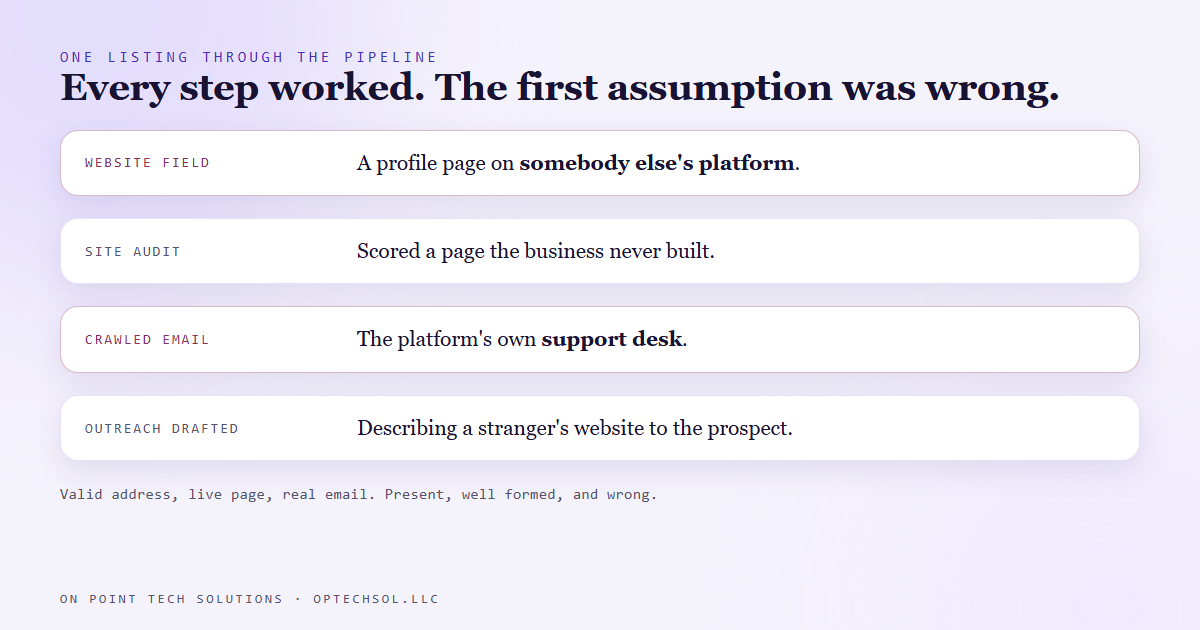
On one sweep, two prospects made it all the way to having outreach drafted before a person reading the list stopped.
The first was a realtor. Their website field was their profile page on a listings platform. The audit scored that platform's page design, and the crawler pulled the one email address it found there. That address belonged to the platform's own support desk.
The second was a handyman whose website field was a listing on a home services directory. Same story. A score for a page he did not build, and outreach describing its problems as if they were his.
Neither message was sent. But think about what they would have said. Hi, we looked at your website and found several places it is losing you leads. Followed by a list of flaws in a page designed by a large company, which the recipient has no control over and possibly has never looked at closely.
That is not a weak cold email. It is worse than sending nothing, because it proves in the first sentence that we did not actually look.
Why validation cannot catch this
This is the part that applies well beyond prospecting.
Most data checks ask whether a value is well formed. Is this a real email address? Does this web address load? Is this phone number the right length? Every one of those passed. The address was valid, the page was live, the email was real.
The value was present, and it was wrong. Present and wrong looks identical to present and right to anything that only inspects the value's shape. The only way to catch it is to ask a question about what the value means, which in this case is: does this address belong to the business in the listing?
The check, and the better pitch hiding behind it
The check itself is small. Take the hostname of the audited address and compare it with a list of known platform hosts: listings sites, directories, free site builders, review platforms, link pages, social networks. Our filter carries twenty of them. If the hostname is on that list, it is not their website, whatever the field says.
What to do next is the interesting part. The obvious move is to drop those prospects. We think that is usually wrong.
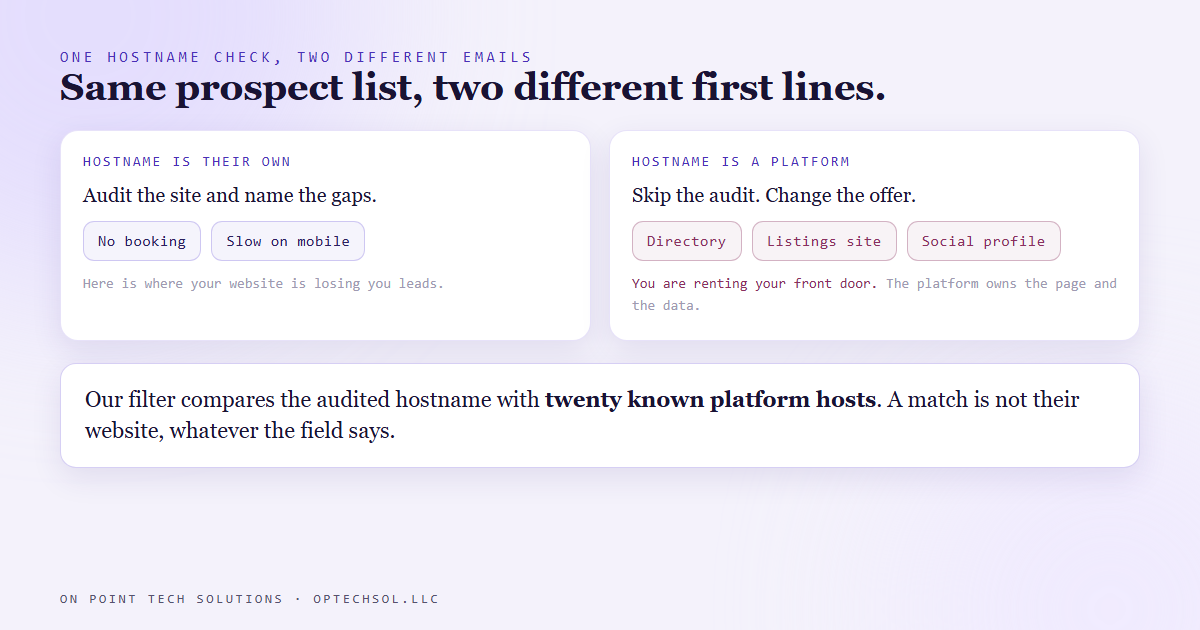
A business whose only web presence is a page on somebody else's platform has a real, specific problem. They do not own it. The platform controls the layout, often puts competitors beside them, can change the rules or the price, and keeps the visitor data. If the platform goes away, so does their website.
That is a stronger opening than a list of design flaws. It is also a different email, with a different first line and a different offer, so the pipeline has to route those prospects somewhere else instead of feeding them into the audit copy.
The lesson we banked is to check whether the hostname is theirs before writing a single word, every time. It takes one comparison and it keeps us from describing somebody else's website to a stranger.
What this means for your business
Two things, depending on which side of this you sit.
If you buy or build lead lists, look at the website column before you trust it. Sort by hostname and see how many are directories, social profiles and free builders. That number is how many personalised messages would have been personalised to the wrong thing.
If you are the business, check what your own Google listing links to. If it is a profile on a platform, you are renting your front door. That is fine as a start. It is a risk as a long term plan, and any GHL consultant Bay Area businesses talk to should raise it before selling anything else.
Either way, the habit is the same. A field being filled in tells you nothing about whether it is true.
Want this built for you
We build websites businesses actually own, plus the CRM, funnels and follow up behind them. Start at optechsol.llc.