Key takeaways
- When a prospect list runs dry, the instinct is to go looking for new geography. In a county you have already worked, that is usually the wrong axis.
- We re-ran three counties that had been swept twice before, using 24 trades that had never been scraped. Only 93 of 1,903 rows came back as businesses we already had.
- The deduplication is by location, so a repeat category in a worked county pays to rediscover contacts that are already in the CRM.
- County level searching under-serves the towns you actually name. One county returned 171 results for its largest city and 38 for a smaller one at the same setting.
- New geography is the right answer only when it is genuinely unswept, and we found one county like that inside our range.
Our sales team ran out of names to call. A good problem in that the calling is happening, urgent in that a quiet dialer costs more than any list does.
The instinct is geography. Drive further out, scrape somewhere new. We had done that twice, and it works until it does not, because the towns close enough to serve well are the ones you sweep first. So before spending anything we asked a different question. Not where have we not looked. What have we not looked for.
Same counties, different trades
Three of our home counties had been scraped twice each, both times with roughly the same twenty trades: the ones you think of first, that obviously need a website and have money.
This run kept all three counties and changed the job types. Twenty four categories that had never been scraped once: general contractor, flooring, concrete, fence, windows, appliance repair, locksmith, movers, auto body, towing, water damage restoration, tax prep, veterinarians, orthodontists, barbers, day spas, sign shops and the rest in that vein.
The whole run pulled 3,198 listings for about fifteen dollars. Of those, 3,089 were businesses we had never seen. Ninety seven percent.
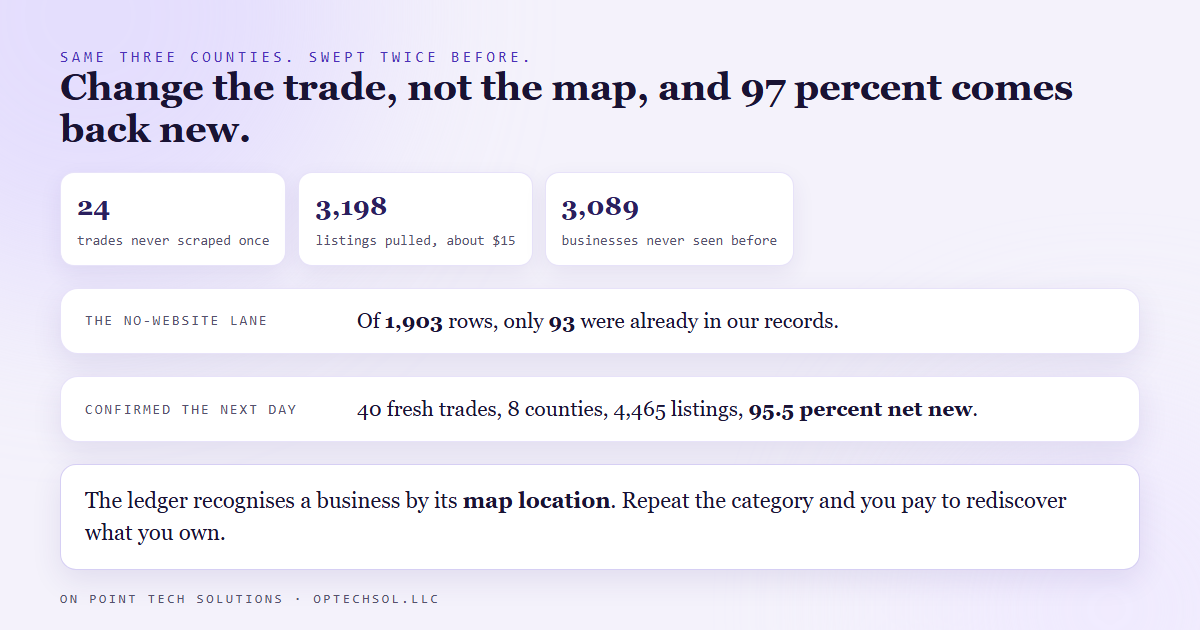
The sharpest number is in the lane we care about most. Of 1,903 businesses with no website on their listing, only 93 were already in our records.
Why it works, and it is the boring reason
Our system keeps a ledger of every business it has ever seen, and recognises them by map location rather than name or phone. A name gets abbreviated and a phone number gets a second line, but the pin stays put.
So running the same category again in a worked county is not a small waste. It is the specific thing the ledger is built to catch: you pay the scraping bill and get back rows immediately discarded as things you already own. A category never run in that county is untouched inventory, and nobody has called those businesses because nobody had their names.
Underneath it is a truth that took two sweeps to see. We never had a lead supply problem. We had a category imagination problem.
Confirmed the next day, at a bigger size
One result is an anecdote, so the following day we ran the same idea deliberately, at scale. Forty fresh categories across eight counties, none used in any earlier sweep: 4,465 listings for about eighteen dollars, 95.5 percent of them net new, nearly 1,200 businesses with a working phone and not one ever called by us. Two runs, the same finding, roughly the same rate. That moves it from something that happened to something we can plan around.
The second finding, which cost us the towns we cared about
There is a trap underneath all of this, and it shows up only when you read the results by city. Scrape a whole county and the results come back weighted by population. In one county at our usual setting the largest city returned 171 results and the second largest 87, while three smaller towns came back with 38, 19 and 18 between them. Those towns are not short of businesses. They were crowded out by bigger neighbours in the same search.
Which matters, because the towns near us are exactly those smaller ones. A county sweep is for coverage. If you name a town, search for that town by name.
We proved it with a cheap follow up: ninety eight searches with the town written into each one, under two dollars all in, 322 new rows weighted toward exactly the towns the county run had starved.
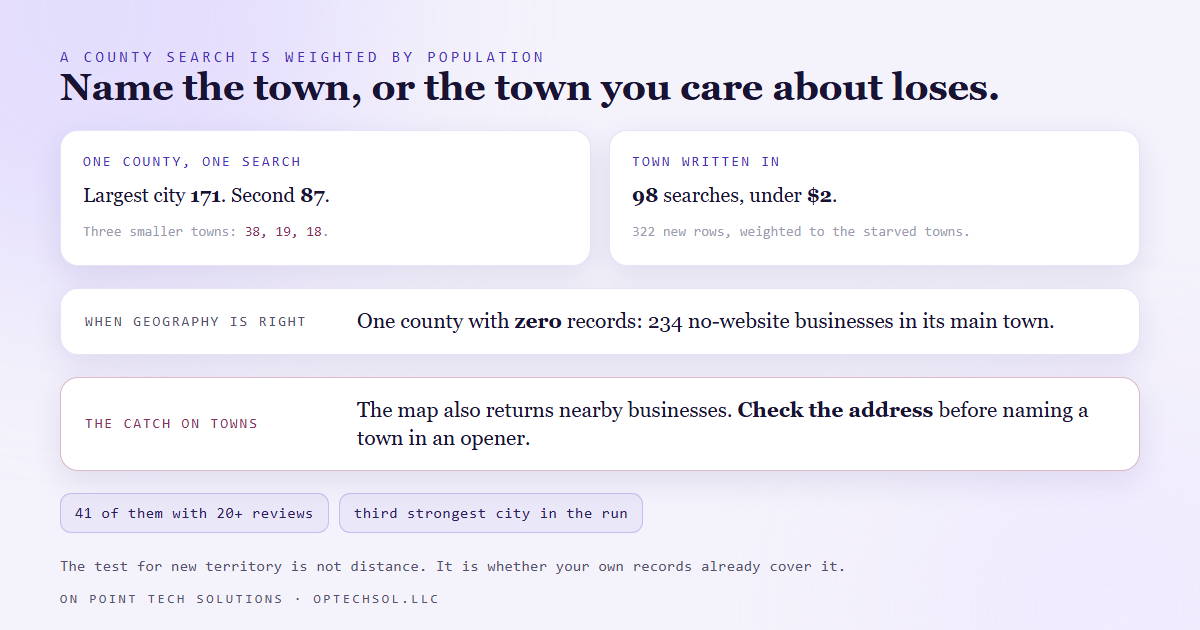
One honest warning. Searching by town name pulls in regional drift, because the map returns businesses from nearby areas that also serve that town. Harmless if you know, but check the address before you use a town name in an opening line.
When geography really is the answer
None of this says never go somewhere new. It says go somewhere new when it is actually new. The same run included one county our ledger had zero records for, and it got the full category list. Its main town alone returned 234 businesses with no website, 41 of them with twenty or more reviews, the third strongest city in the entire run. That is what unswept territory looks like, and it looks nothing like a county you have worked twice.
The test is not distance. It is whether your own records already cover it.
What this means for your business
The shape of this goes well beyond prospecting. Whenever a source of new customers dries up there are usually two axes you could spend on, and people reach for the one that is easiest to picture: wider radius, bigger audience, more towns.
The axis with room left is usually the one you have held constant without noticing. For prospecting it was the trade list. For ads it is the offer rather than the targeting. For a service business it is the type of job rather than the area you drive to.
Three things worth doing this week. Write down what you kept constant across your last three attempts at growth, because that is your candidate. Before buying a new list, check how much of it you can already reach, since the answer is often most of it. And keep a record of what you have tried, keyed to something that does not change, so the next attempt can tell new from repeat without anybody remembering.
For a GHL consultant Bay Area business sitting on a CRM full of old contacts, that last one is the cheapest win available. Most lists are less stale than they look, and the ones that really are spent are usually spent on one axis only.
Want this built for you
We build prospecting systems that know what they have already seen, and spend on the axis that still has room. Start at optechsol.llc.