Key Takeaways
- Russ Ward runs 37 paying customers with one full time team member, and every client sits on a HighLevel sub-account he owns. No exceptions.
- One speaking panel turned into roughly 120 members at $97 a month, moving his recurring revenue from zero to about $12,000 a month.
- Monthly gross swung from negative $122 in August 2023 to $22,115 in August 2024. Year totals were $112,590 and $139,060.
- He once sold $60,000 to $80,000 of an offer he could not deliver and refunded most of it, because lead costs ran $20 in one city and $180 in another.
- The answer to "your leads suck" was never better leads. It was qualification.
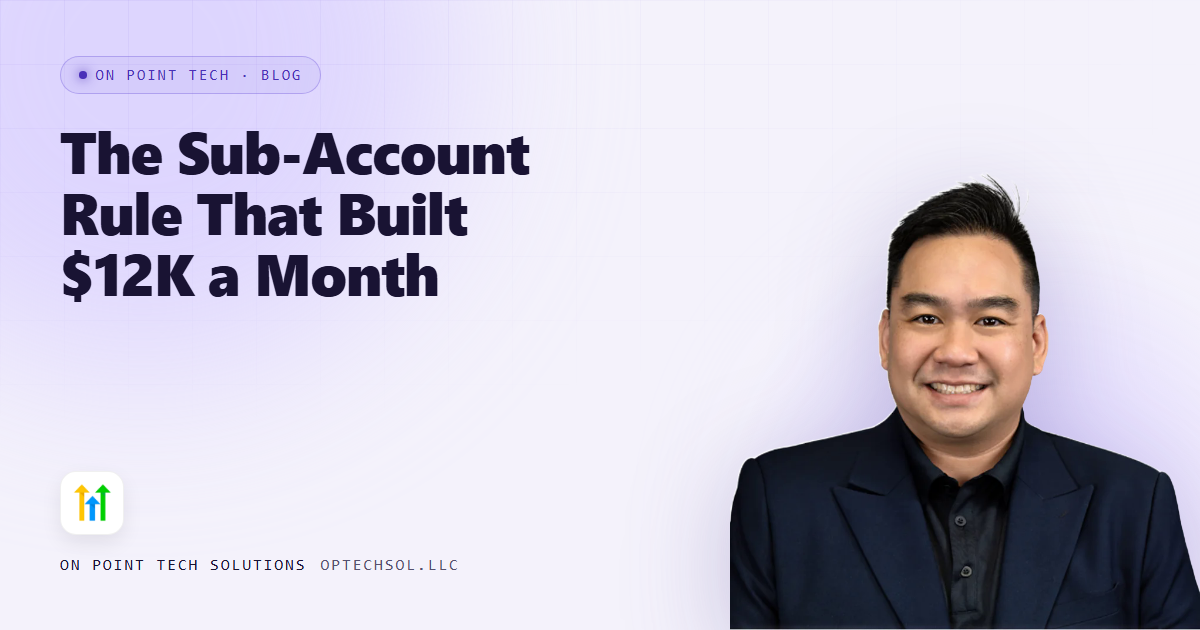
HighLevel published a long case study with Russ Ward, who most of the community knows as The Lead King, as part of their HighLevel Breakthroughs series. It runs 65 minutes and a good chunk of it is a hard personal story about bankruptcy, a lawsuit, and starting over with nothing. That story is his to tell and the video tells it well, so watch it there. What we want to pull apart is the business underneath it, because the revenue mechanics are the clearest case for recurring revenue we have heard a HighLevel operator make on camera. If you are shopping for a Go High Level San Jose partner, this is the part worth copying. On Point Tech Solutions builds this structure out of Los Gatos for clients across San Jose and the Bay Area.

The One Rule: Everybody Runs On Your Platform
Ward has one non-negotiable and he says it plainly. Everybody who works with him has to have a HighLevel account, and it has to be one of his. Not a tool they already like. Not a spreadsheet. Not your platform, mine.
He is specific that this is a SaaS sub-account, not an affiliate signup. That distinction is the whole thing. An affiliate commission is a referral fee on somebody else's relationship. A sub-account is a customer on your platform, with your billing, your support, and your logo on the login screen. Same client, completely different asset.
Most agency owners skip this rule because it feels like friction on a sales call. It is friction. It is also the difference between a business you have to sell again every month and one that wakes up with revenue already booked.
What a Single Speaking Panel Was Actually Worth
In 2024, Ward got invited to speak on a panel at an AI summit. He talked for five or ten minutes about building voice bots for local companies. Roughly 200 people lined up afterward. He collected their contact information and opened a paid community at $97 a month.
About 120 of them joined, and every one got a HighLevel sub-account from him as part of it. His recurring revenue went from nothing to around $12,000 a month in a matter of days. The two gold SaaSPRENEUR awards on his office wall trace back to that one room.
Now the honest part, and it is worth reading twice. He had no plan to keep the group full. No system to replace members who left, so churn ate into it month after month and 2025 turned into a grind. The lesson is not that speaking works. It is that a launch is an event and a business is a process, and he built one without the other.
The Expensive Lesson Sitting Behind the Good Numbers
Before any of the recurring revenue, Ward sold an offer he describes as "I will build you a solar marketing department." Generate the leads, qualify them, drop appointments on the calendar. It sold extremely well. He brought in somewhere between $60,000 and $80,000.
He refunded most of it. Not because the marketing failed, but because lead costs swing wildly by geography. A solar lead cost about $20 in Pittsburgh and about $180 in Los Angeles. He had priced one number and promised one outcome across markets where the math was not remotely the same.
That is a sobering number to put in a public case study. Selling faster than you can deliver does not just cost you the refund. It costs the referral, the testimonial, and the year you spend rebuilding trust.
Where AI Finally Earned Its Keep

Ward spent years hearing the same complaint: the leads suck. He knew they did not, because he would pick up the phone himself and book appointments off the same list. The clients were not calling. That is a follow-up problem wearing a lead-quality costume.
The fix is worth stealing. In his car dealership partnership, a messenger bot qualifies the inbound lead, an AI voice agent calls the qualified ones, then transfers live to a human rep at the dealership. Nobody on the client side has to remember to follow up, because it happens whether they remember or not.
That partnership, added in October 2025, now covers most of his monthly retainer revenue at around $6,000 a month. He is blunt that nobody else in his niche is doing it, which is exactly why it works.
Why This Matters for Bay Area and San Jose Businesses
Two things in this case study land hard in a market like ours.
The first is the lead cost gap. The Bay Area is the expensive end of every ad auction. If a solar lead runs $20 in Pittsburgh, you are not paying $20 here, and any agency quoting you a national average is quoting you a number that has nothing to do with your zip code. Ask what a lead costs in San Jose specifically. If they cannot tell you, they have not run it here.
The second is the follow-up gap, and it is bigger. Most local businesses in this valley are not losing deals to competitors. They are losing them to a voicemail nobody returned by Thursday. The stack Ward describes answers that without asking anyone to change their habits, which is the only kind of system that survives contact with a busy shop. Good marketing automation San Jose businesses will actually use is automation that runs when the owner forgets, not automation that needs the owner to remember.
Practical Steps
- Pick one thing clients pay for once and work out what the monthly version looks like. Even a small recurring number changes how the month starts.
- If you resell software, put clients on your own sub-account instead of sending them to sign up elsewhere. You want the customer, not the referral fee.
- Price the delivery in your actual market before you price the offer. Not the national average, your city.
- Build the refill system before the launch. A community, a list, or a pipeline with no intake is already shrinking.
- Put qualification in front of your sales team. Screen the lead, call the lead, transfer the live one. The speed is what closes it.
Watch the Full Case Study
Final Thoughts
The headline number here is $12,000 a month from one panel. The durable number is 37 customers run by one person, because that ratio only exists when the systems do the repetitive work. Credit to Russ Ward for putting the refunds and the churn on camera next to the awards. Case studies that only show the wins teach nothing.
On Point Tech Solutions is a Go High Level San Jose and Bay Area consultancy based in Los Gatos. We build the websites, funnels, and automations that make this structure run, and our clients own what we build. Done for you, or taught to your team with an SOP so you are never locked out of your own business. See what we do at optechsol.llc.