Key takeaways
- Our own online store went live carrying testimonials from customers who do not exist, with full names and specific results. Nobody on our side wrote them. The AI site builder did, as placeholder copy.
- Alongside them: invented totals for customers and reviews, four different customer counts across the same site, and a performance promise sitting right next to the buy button.
- The same fake block turned up in five files, including one component no page even loaded. Checking the homepage would have missed most of it.
- A day later we found the same failure in a different place: the knowledge base behind our chat assistant, quoting an hourly rate we have never charged to real leads.
- The fix is to replace invented proof with claims the product can prove on its own, and to make any missing proof look broken in the draft rather than plausible.
We sell physical tap cards that send a customer straight to a business's review page. The store for them was built quickly with an AI site builder, which is exactly what those tools are good at. Layout, product pages, a checkout, all in an afternoon.
In July we read the live site properly, top to bottom, the way a stranger would. It was selling. It was also full of people who had never existed.
What was on the page
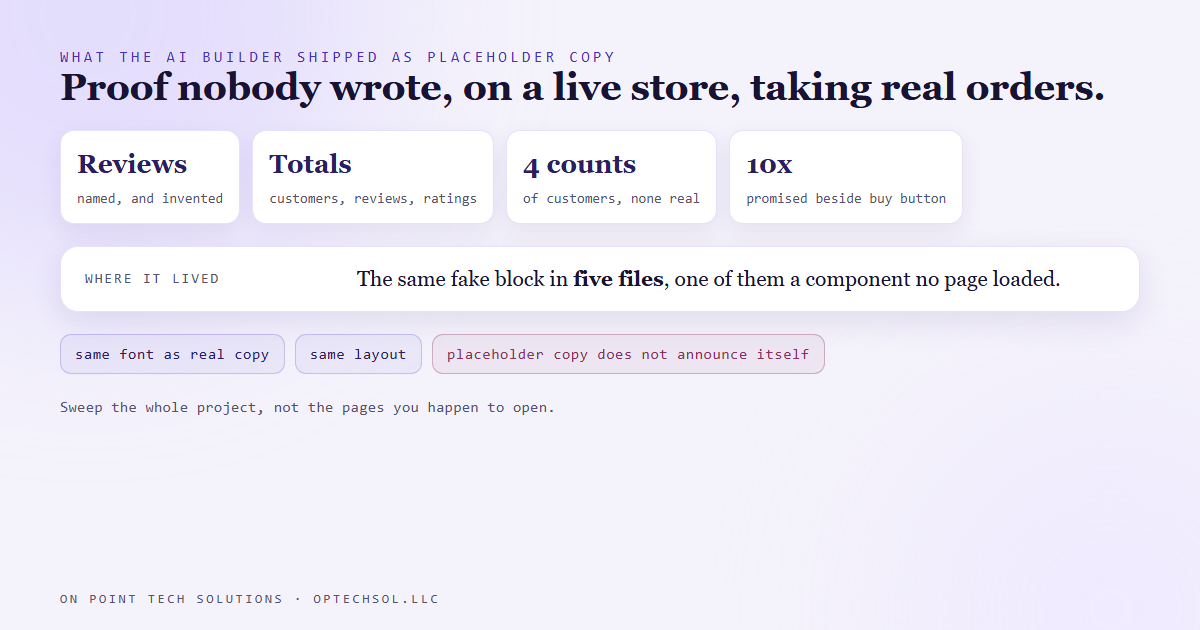
A testimonial section with named customers, each attached to a named business and a specific before and after. The kind of line that sells: a coffee shop going from a handful of reviews to hundreds in a few months.
A row of big round numbers. A hundred thousand happy customers, fifty thousand reviews generated, an average rating to one decimal place, a satisfaction percentage.
Customer counts that disagreed with each other. One page said over a thousand, another over five hundred, another hundreds, another thousands. Four different numbers on one small store, none of them from a real count.
And on the product page, next to the button that takes money, a promise that businesses see up to ten times more reviews in their first thirty days.
None of it was written by a person. It is what these builders produce when they are asked for a store and nobody supplies the proof. Placeholder copy, in the same font and layout as the real copy, and it does not announce itself.
Why this is the worst copy on any site
Most bad website copy is merely bad. It is vague, or long, or boring, and it costs you some conversions.
Fabricated proof is a different category. An invented testimonial with a name and a result is a false statement about a sale that never happened. A performance promise next to the buy button is a claim somebody can hold you to. Both are the kind of thing consumer protection rules exist for, and small business owners, the exact people who buy review cards, are the ones who take them most literally.
It is also the copy that works hardest against you when found. A customer who spots one made up review stops believing the real ones.
It spreads into files nobody looks at
We found the fake testimonial block in five separate files. Some were pages. One was a component that no page imported at all, sitting in the project, waiting for the next edit to wire it back in.
That is why the sweep has to cover the whole project and not the pages you happen to open. We searched every file for the patterns this kind of copy leans on: phrases like trusted by and happy customers, anything with a K and a plus sign, percentages, ratings to one decimal place, words like thousands and hundreds, multipliers like ten times, and any name that looked like a persona. Then we read every hit.
The same failure, somewhere else
The next day we rebuilt the knowledge base behind our website chat assistant, the thing that answers questions from people who land on the site.
It held two dozen older answers that nobody here remembered writing. They described an agency that does not exist. An hourly consulting rate we have never charged. A rush fee, a fixed number of revision rounds, a cancellation policy, a dedicated project manager, a staffed team with account managers, and a portfolio we could not point to.
Specific, plausible, never true. The same failure as the fake reviews, in a place with no page to read. It had been answering real inquiries for roughly a year. Every one of those answers was deleted and replaced with pairs generated from our actual rate card and service documents.
What replaces it
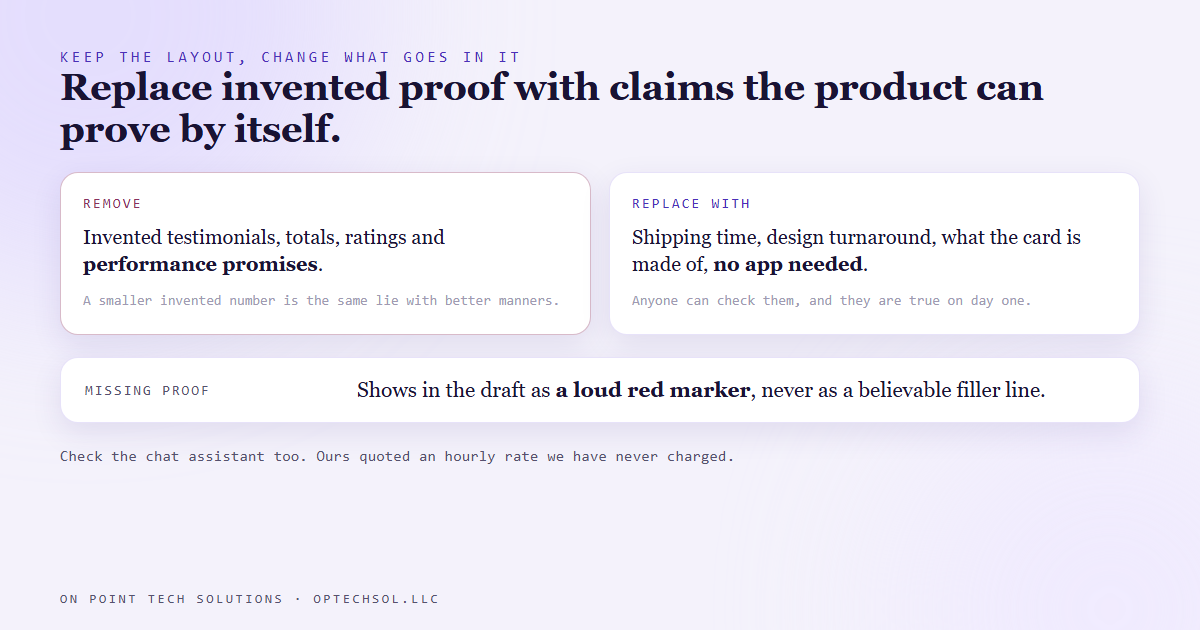
The honest move is not a smaller invented number. Swapping a hundred thousand happy customers for five hundred is the same lie with better manners.
We kept the layouts, because a four across row of stats looks good, and changed what goes in them. Claims the product can prove by itself: how fast it ships, how long a custom design takes, what the card is made of, that the customer does not need an app. Anyone can check those, and they are true on day one with zero sales.
The testimonial section comes back when there are real customers willing to be quoted, with their permission.
On newer pages we went a step further. Where a page needs proof we do not have yet, the draft shows a loud red marker saying so, instead of a believable filler line. A missing screenshot or an unconfirmed number stays visibly unfinished until someone supplies the real thing. Placeholder copy is only dangerous when it looks finished.
What this means for your business
If any part of your site came from an AI builder, a template, or an agency working from one, assume there is invented proof in it until you have checked.
Three things worth doing this week. Read every testimonial on your site and confirm you can name the real customer behind it. Search every page, not just the homepage, for round numbers, percentages and ratings, and trace each one to a source. And ask your chat widget or AI assistant what you charge and what your policies are, because it may have been answering from a script nobody on your team wrote.
For a GHL consultant Bay Area business, the chat assistant is the one to check first. Pages get read by the owner now and then. The assistant talks to your leads all day.
Want this built for you
We build sites and AI assistants that only claim what the business can prove. Start at optechsol.llc.