Key takeaways
- This fall we had long recorded conversations with Bay Area tax and bookkeeping professionals about how they use AI, plus a stack of contractor calls where the books came up again and again.
- The accountants we talked to are careful with AI on purpose. Client data stays out of public tools, and that caution is exactly what makes their AI use safe to grow.
- Where AI is already helping them: marketing, firm procedures, admin work, and checking their own formulas with numbers that identify nobody.
- The easiest first win is writing down a short rule for what never goes into AI, then handing it one admin chore.
If you think accountants are behind on AI, talk to a few. I did, and I came away thinking they might be the smartest users I've met.
Part of my job as a GHL consultant in the Bay Area is sitting down with business owners to learn how they actually work. This fall that included long recorded conversations with tax and bookkeeping professionals, one running a tax practice and one doing bookkeeping and advisory work for small businesses. On top of that, three of the construction businesses we met spent half their call telling us their real headache was the books. Put together, it's a clear picture of how the numbers side of small business is using AI right now.
What we're hearing from Bay Area accountants and bookkeepers
The first thing both professionals said was about privacy. Neither puts sensitive client data into a public AI tool. One practice is waiting to see what AI features its tax practice software rolls out, because taxes and AI is a sensitive pairing and they want it built into a system they already trust. The other uses AI every week, but only with numbers that point to nobody.
Some people hear that and think "behind." I hear a firm with a rule. And a firm with a rule can add AI one safe step at a time.
The second thing: both are growing, and both want to spend more time advising clients and less time on admin. One firm is moving more of its work toward tax planning. The other is growing its team and wants the admin handed off cleanly.
Five ways AI is already helping accounting firms
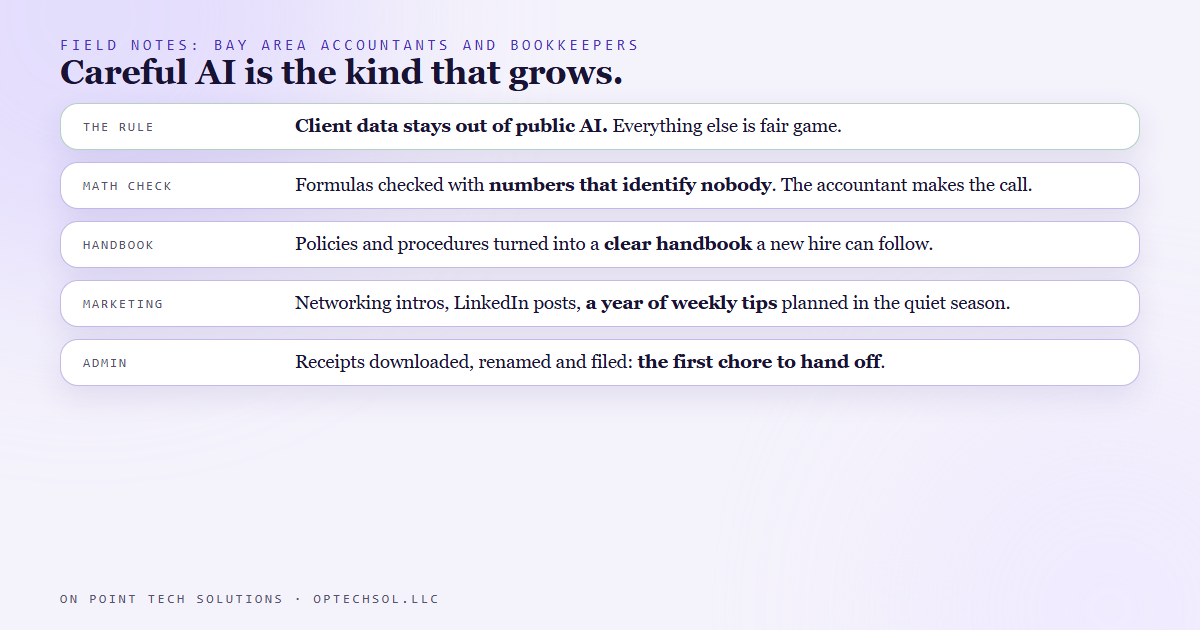
1. A sanity check on the math. One professional told us they use a chat AI as a second set of eyes on their own models. They type in the numbers with nothing that identifies a client, and ask whether the formula is right or whether a better one would record cleanly in the books. The judgment stays with the accountant. The AI just catches the slip.
2. Writing the firm's own handbook. Ahead of bringing on help, that same professional used AI to turn their policies and procedures into an easy-to-read handbook. That's a perfect AI job: the knowledge is all yours, and the output is a clear document a new hire can follow on day one.
3. Marketing in a fraction of the time. Short networking intros, LinkedIn posts, a year of weekly tax tips. One firm talked about using the quiet weeks after tax season to plan 52 weeks of tips at once. AI makes that kind of batch work realistic for a firm without a marketing person.
4. Handing off the admin. Downloading client receipts, renaming them, uploading them to the accounting software. Nobody became an accountant to do that, and it's the first thing these firms want off their plate, whether it goes to a new hire, an automation or both.
5. A second read of their own paperwork. One professional runs their own engagement letter template past AI to make sure it covers the points they care about, then makes the final call themselves. AI as a proofreader on your own documents, with you as the expert, is a safe and useful pattern.
What the leaders have in common
They have a clear line. Client data doesn't go into public AI. Everything else is fair game. That one rule makes every new AI idea easy to judge.
They grow on reviews and referrals. One firm told us most of its volume comes from Google reviews, not cold outreach. They send a review link through their practice software once a client's return is done, and they planned to resend it to happy clients who hadn't left one yet.
They write things down. Procedures, onboarding steps, the monthly close. Written steps are what let a firm hire, and they're also what lets AI help.
They keep a person in charge. Every use we heard about ends with the accountant checking the work, which is what makes AI trustworthy enough to use anywhere near a client's business.
Your first week with AI as an accountant or bookkeeper
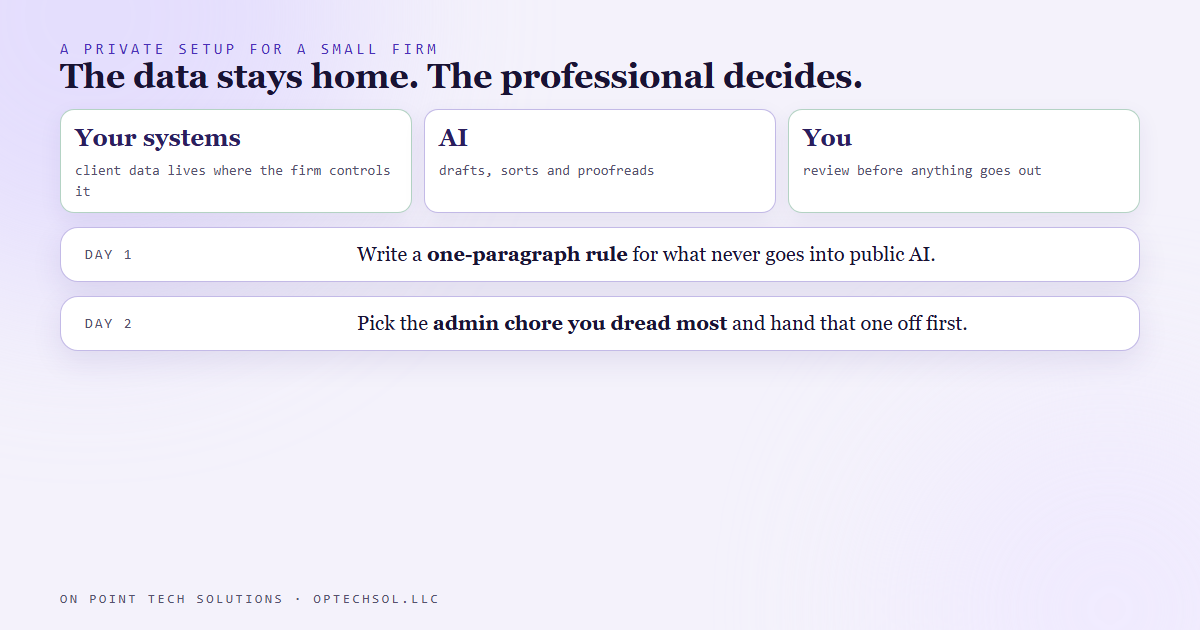
- Day 1: Write a one-paragraph rule for what never goes into a public AI tool. Share it with anyone who helps you.
- Day 2: List your most repetitive admin chores. Pick the one you dread most.
- Day 3: Use AI to turn one of your procedures into a clean, step-by-step document.
- Day 4: Draft a month of weekly tips for LinkedIn and approve them in one sitting.
- Day 5: Ask your practice software provider what AI features are coming and how they handle your data.
Why this matters for Bay Area firms, from a GHL consultant's view
Here's what the contractor calls taught me. Small business owners all over the Bay want help with the books, and more and more of them are asking whether AI can sort transactions by job or chase down receipts. The firms that already know how to use AI carefully are the ones those owners will trust with that work.
As a GHL consultant in the Bay Area, the setup I recommend for firms like these keeps client data in systems the firm controls, uses AI for drafts and admin, and leaves every final answer to the professional. That's the careful approach these accountants already practice, and it's a great foundation to build on.
Want to learn how to set this up?
Join the On Point Tech Academy at optechsol.llc/academy. It's free, and we build live every Tuesday and Thursday.
The On Point Tech Academy costs nothing and never asks for a card. We build live every Tuesday and Thursday, 12:30 to 1:30 PT.
Join the Academy free ← Back to all Field Notes