A plumber missed a call while he was under a sink. Eight seconds later the customer had a text back. By the time he stood up and wiped his hands, the water heater job was booked for Tuesday at nine. He never touched his phone.
That is not a product. It is three things wired together in Go High Level, and I built the whole thing on screen in about twelve minutes on a demo account. Here is the build in writing, including the one thing that will stop it working on day one if nobody warns you.
Your phone is not ringing less. You are just not there
This is the part trade owners do not enjoy hearing. About 62 percent of calls to small businesses go unanswered. That figure comes out of a 411 Locals study of 85 businesses across 58 industries, where a live person picked up 37.8 percent of the time.
Then the second number does the damage. Around 85 percent of the people who land in your voicemail never call back. They do not leave a message and wait. They scroll down and call the next plumber.
So the lead was not lost to a competitor with better marketing. It was lost because the owner was on a job, which is where an owner is supposed to be. Every trade business I talk to in San Jose has the same shape: the receptionist and the technician are the same person, and that person is under a sink.
The old fix is a live answering service. Call Force publishes HVAC tiers at 300 dollars a month for under 25 calls a week and 650 for 25 to 100, and Ever-Help puts home services at 450 to 650. Several hundred a month for a stranger reading a script who cannot see your calendar.
The build below replaces that, and marketing automation San Jose businesses can run themselves is exactly what it is: three steps, three tests, no new software to learn.
Step one: the missed call text back
This is one workflow, and it is the highest value thing most owners will ever build in this software.
The trigger is call status, missed. That is the entire trigger. Then a wait step of eight seconds, which matters more than it sounds like it does, because a text that fires the instant somebody hangs up reads like a robot. Eight seconds reads like a person who just got free.
Then one message:
Hey, this is Mike's Plumbing. Sorry we missed you, we're on a job. What's going on? If it's urgent, reply 1. If you want a time, grab one here: mikes.plumbing/book
First name pulls in automatically. That is the whole workflow. Three steps and one link.
The words in that text are doing more work than the automation is. It says who you are, it explains the silence, it asks a question, and it gives an urgent caller somewhere to go that is not your voicemail.
Test one, because every step gets tested
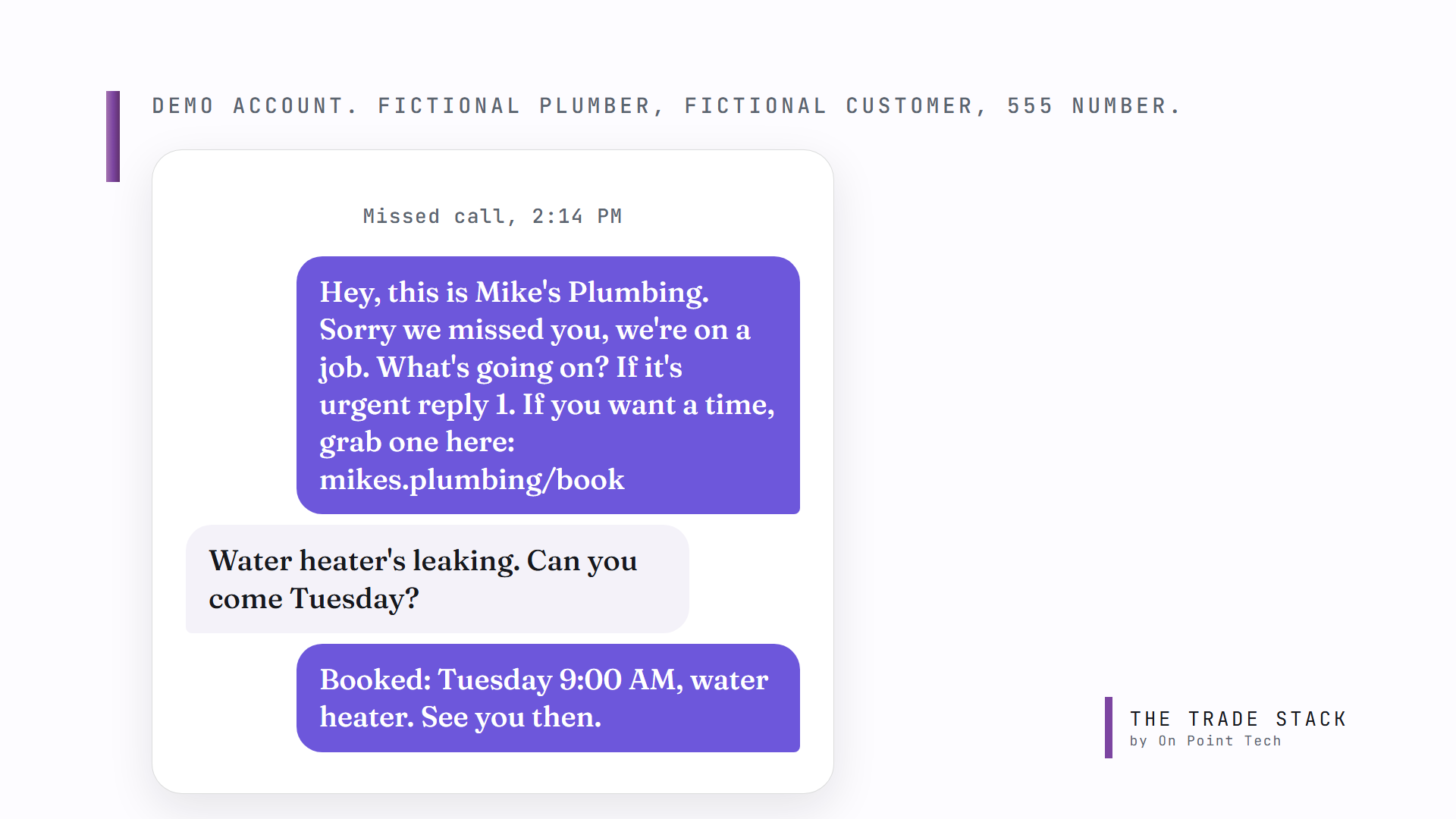
I called the number from my cell and hung up. Eight seconds later the text landed. I replied that the water heater was leaking and asked about Tuesday, and the whole thread dropped into the conversations tab with every other text.
Nothing clever happened. That is the point. One text is the difference between your customer and somebody else's customer.
Step two: the calendar the link points at
A booking link has to go somewhere real, so the next step is a booking calendar.
One service, water heater, ninety minutes, with a thirty minute buffer so nobody is scheduled to teleport across town. Working hours seven to five, Monday through Saturday.
Then the setting almost everyone skips: turn the confirmation text on. The customer gets the time in writing the second they book, and so does the owner. Two minutes of work if you do not overthink it.
Test two took as long as tapping the link. I picked Tuesday at nine on my phone, the confirmation hit, the appointment showed up on the contact record, and the pipeline card moved along on its own. The plumber did nothing. He was still under the sink.
Step three: a voice for after six
Texting is fine at two in the afternoon. At nine at night with water spreading across a floor, people want to hear a voice.
So the last step is a voice agent. In Go High Level that is AI agents, voice AI, new agent. She gets a name, a greeting, and three jobs: ask what is going on, ask where they are, offer the next open slot on the same calendar the text points at.
And one hard rule written into her prompt. Never quote a price. Prices come from the plumber, not from the phone. That single line is what keeps an AI receptionist from creating a problem your invoice has to argue with later.
During business hours she stays off. After six she picks up.
Test three: I called after six, she answered in two rings, asked what was going on, asked whether it was flooding right now, and offered Tuesday at nine or an emergency slot that night. I took Tuesday. Same calendar, same confirmation text, and the call transcript was sitting on the contact when the plumber woke up.
The gotcha nobody tells you until launch week
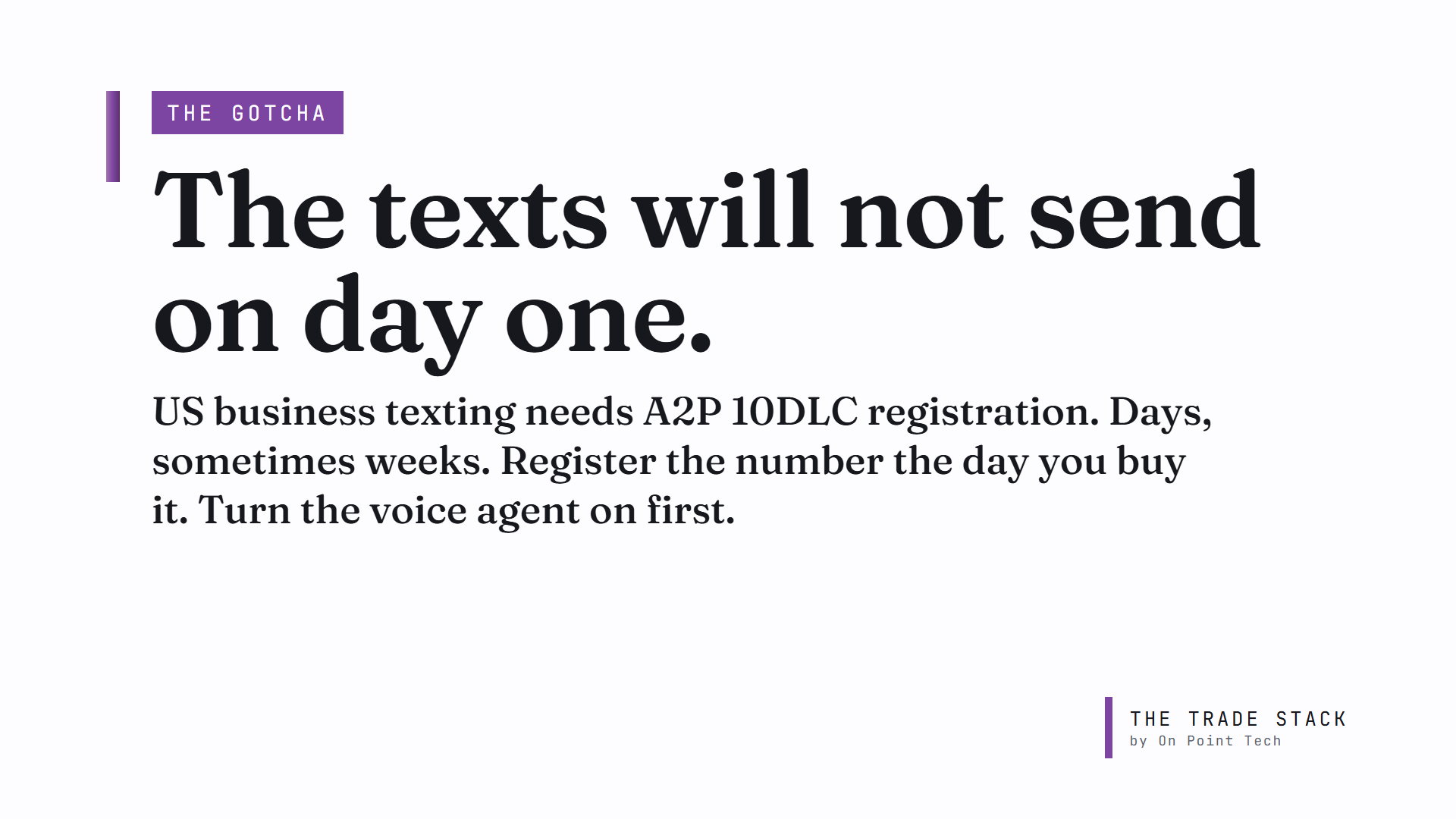
Build all three steps perfectly and your texts still will not send on day one. Not because you did it wrong. Because business texting in the US needs the phone number registered with the carriers, which is A2P 10DLC. You submit the business details, the carriers approve it, and that takes days. Sometimes a couple of weeks.
Two things follow from that. Register the number the same day you buy it, before you build anything. And turn the voice agent on first, because she does not need that registration and she can carry the phone until the texts clear.
Most owners find this out the week they were planning to launch.
What it actually replaces
Three steps. Three tests. About twelve minutes of building, plus whatever the carriers take.
What comes out the other side answers every missed call in eight seconds, books straight into a real calendar, and picks up the phone at night with a voice that knows your hours and refuses to quote a price. Set against a few hundred dollars a month for a stranger with a script, the math stops being interesting fairly fast.
The build above is public. Comment SETUP on the video and the workflow, the exact text, the calendar settings and the voice agent prompt are yours, free.
If you would rather have it running by tomorrow than build it yourself, that is what we do at On Point Tech. AI receptionist, 299 dollars a month, no contract. We are in Los Gatos and we build these for trades across San Jose and the rest of the Bay Area.
Built on a training demo account. The business, the customer and the phone number are fictional. Next build: the same idea for an HVAC company, where the job is dead quotes.
Want to build this yourself? Join the On Point Tech Academy. It's free, and we build live every Tuesday and Thursday.
The On Point Tech Academy costs nothing and never asks for a card. We build live every Tuesday and Thursday, 12:30 to 1:30 PT.
Join the Academy free ← Back to all Field Notes