Key Takeaways
- An answering service does not sell you a person. It sells you minutes. Ruby publishes 50 minutes for $250 a month, which is $5.00 a minute to pick up and take a message, and even its 500 minute plan still works out to $3.45.
- Most per minute services bill in whole minute increments and round every call up, so a 40 second call bills as a minute. That is the standard increment in the industry, not a scam.
- What replaces the service is not the hello. It is the message slip: the transcript on the customer's record, a plain English summary, the contact saved, the appointment booked, and a task only if somebody needs to call back.
- Do not cancel the old service first. Get your own number, point your forwarding at it yourself, run both for two weeks, then cancel.
A call comes in at nine at night. Nobody is in the office. The AI picks up on the second ring, asks what is going on and where they are, offers the next open slot on the real calendar, and books it. By morning the whole thing is on that customer's record with the appointment already on the schedule.
That is the build we walked through on The Trade Stack this week. We are On Point Tech Solutions in Los Gatos, and we build this for trade businesses across San Jose and the Bay Area. This one is a comparison rather than a fix, because the thing it replaces has a published price you can check yourself.
You are not buying a person, you are buying minutes
Here is how everybody ends up here. You cannot answer the phone because you are under a sink, so you look at hiring somebody to sit next to it. The median wage for a receptionist is $18.27 an hour, or $38,010 a year, per the Bureau of Labor Statistics. You do not have $38,000 for a chair.
So you get an answering service instead, at three hundred to six hundred fifty a month in the contractor tiers. It feels like the cheap option right up until the first bill shows up with minutes on it.
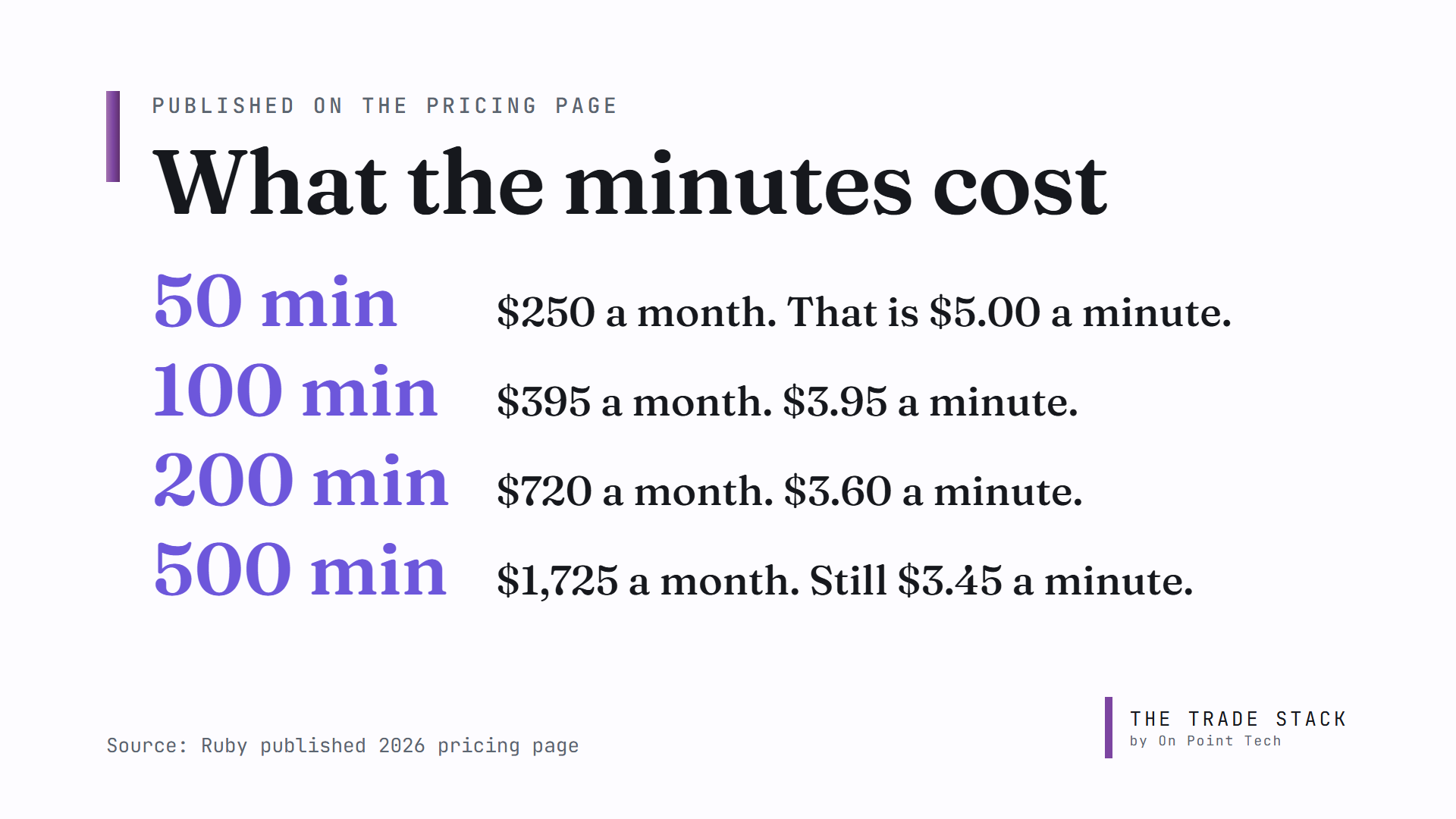
Do the division. Fifty minutes a month is under one minute a day, and none of that is hidden. Go open the page yourself.
The meter is worse than the sticker
The rate card is only half of it, because of how the clock runs. Most services bill in whole minutes and round every call up to the next one. A forty second call is a minute. A call that runs one second past a minute is two minutes.
That is not a scam. It is the standard increment, and one answering service says so on its own blog while telling you it bills in six second blocks instead, which tells you what the rest of them are doing. No percentage is claimed here, because every number floating around for what rounding adds to a bill traces back to a vendor selling the alternative.
What the voice agent does instead
I want to be specific, because this is where people oversell it. The agent picks up on the first or second ring, every time, and books the next open slot on your real calendar. It is not smarter than a good operator. It is awake at two in the morning, and you are not paying a human's hourly time to be awake with it.
Then comes the part that actually replaces the service. What you were buying from that company was never the hello. It was the slip of paper on your desk in the morning. Here is what shows up instead: the call transcript on the customer's record, a plain English summary of what they wanted, their name and number already saved as a contact, the appointment on the calendar, and a task only if somebody needs to call them back.
Every one of those lines used to arrive by reading a slip and typing it into your software yourself, and that typing was never free either. So the honest comparison is not three hundred a month against zero. It is three hundred plus the retyping, against a system that writes it down where it already lives.
Three calls a human should still take
This is the part I would want to hear if I were the one shopping. First, the emergency. Gas, smoke, water on the floor right now. The agent's only job on that call is to hear it and get a person on the line in one step, not to book it for Tuesday. Second, price. Nothing on that phone ever quotes a number, because a price out of a phone robot is a price you are going to eat. Third, the complaint. Somebody calling about a job you already did is a retention call, and that is the cheapest phone call you will ever take.
So the service still wins on judgment. A good operator hears somebody crying on the phone and does something about it, and no agent I have used does that yet. Where it loses is the thing you were mad about in the first place: the person answering cannot answer a real question about your business. They read the script you gave them. This reads the same script and does not charge five dollars a minute to read it.
Do not cancel the answering service first
Your calls are reaching that company somehow. Usually it is a forward off your main line. Sometimes it is worse, and it is a number that company owns and you have had printed on a truck for six years. Cancel first and you find out which one it was on a Monday, with a dead phone.
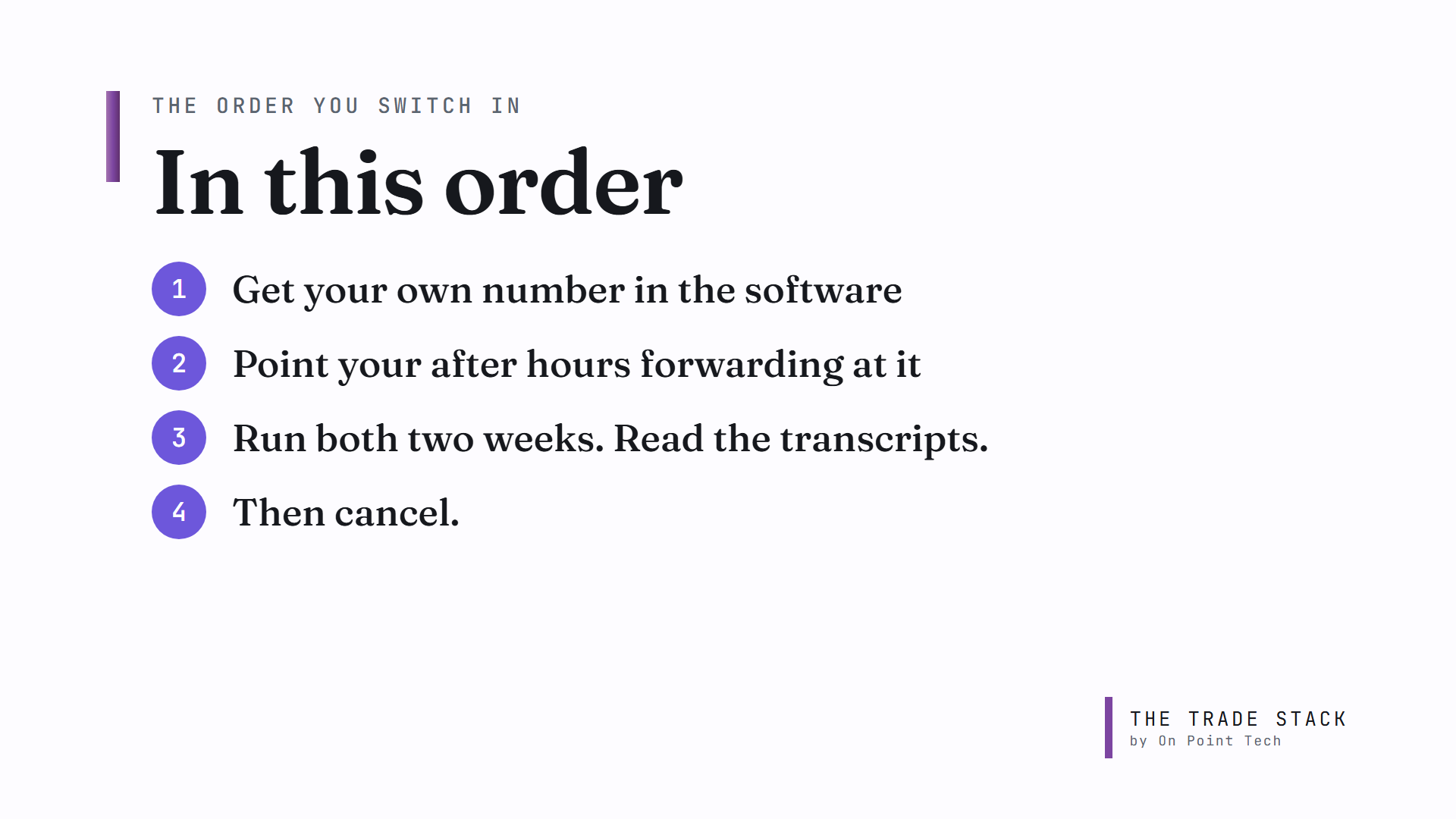
Two weeks of paying twice is the cheapest insurance in this build. Read the transcripts while both are running. If the agent is fumbling a question your customers keep asking, you fix the prompt while the old service is still catching the calls.
Why this matters for San Jose and Bay Area trades
Labor costs more here than almost anywhere, so the math on a receptionist is worse for a South Bay contractor than for the same shop in another state. That pushes owners onto a per minute bill earlier, and most never priced it out.
It is also a market where homeowners call three companies, and the one that picks up at nine at night is often just the one that gets the job. That has nothing to do with being the best plumber on the list, and it is why Go High Level San Jose contractors keep landing on this same build. It carries across too. Plumbing, HVAC, electrical, roofing, landscaping, remodeling. Any trade where the owner is the receptionist.
Practical steps
- Open your answering service invoice and find the minutes line. Divide the bill by the minutes. That is your real rate.
- Get your own phone number inside the software, so the number your customers reach is one you own.
- Write the agent prompt around your actual service area, your hours and what you do not do, then connect the real calendar and set how far out it may book.
- Build the three escalation rules: emergency goes to a human in one step, no price is ever quoted, and a complaint routes to a person.
- Point your after hours forwarding at your new number yourself, rather than asking the old service to do it.
- Run both for two weeks and read the transcripts. Then cancel.
Watch the build
Everything on screen was built on a training demo account. The plumbing company, the customer and the phone number are fictional. No answering service was called for this and no live call was put through the voice agent, so nothing here is a measured result. The arithmetic is done on published price pages you can open yourself, and the build is real.
Want it running by tomorrow
On Point Tech Solutions is a Go High Level consultant in Los Gatos, serving San Jose and the Bay Area. We build websites, funnels and automations like this one, and our clients own what we build. Done for you, or taught to your office with the SOP in your hands.
Come see the rest of it at optechsol.llc.