Key takeaways
- Since August we've had recorded sit-downs with five construction and trade businesses around the Bay Area: remodelers, a custom builder, a general contractor, a fabrication shop and a paving crew.
- The owners getting real value from AI didn't start with ads. They started with estimates, the books, and the first reply to a new lead.
- Every one of them wants the same setup: AI does the first draft, a person checks it. Nobody wants software making the final call on a bid.
- The easiest first win is an instant, friendly text to everyone who asks for a quote, with follow-ups you set once.
When I sit down with a contractor, I figure we're going to talk about leads. About half the time we end up talking about spreadsheets.
I help businesses with marketing automation in San Jose and around the Bay, and the trades are the group I talk to most. This fall that meant five construction and trade businesses on recorded calls, some of them several times. Put those conversations side by side and a pretty clear picture shows up of where AI is already earning its keep on job sites, and where owners want it next.
What we're hearing from Bay Area contractors
The first thing: work isn't the problem for most of these crews. A couple of them get nearly everything from referrals and general contractors and barely market at all. What slows them down is everything around the work. Estimates live in an app on the owner's phone. Expenses live in a spreadsheet someone updates at night. Contracts, change orders and photos live in email, texts and a folder on somebody's laptop.
Three of the five told us the same thing in different words: they want one place where the customer, the estimate, the paperwork and the money live together, and they don't want to switch systems again in two years.
The second thing: almost everyone is already using AI a little, quietly, on their own. That's where the good ideas are coming from.
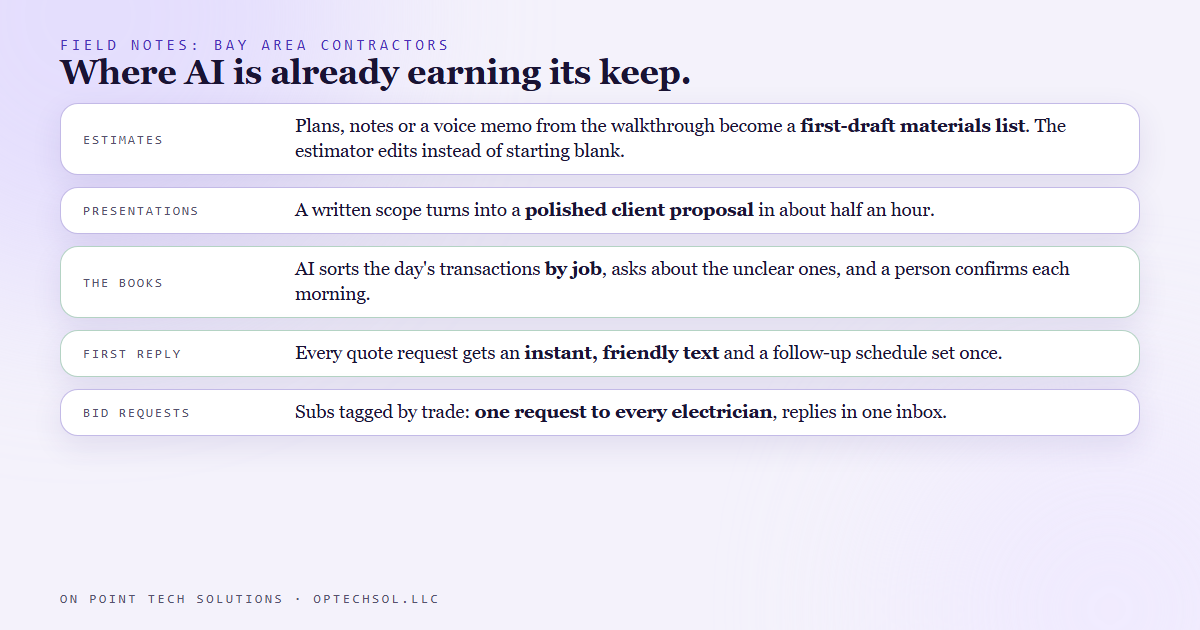
Five ways AI is already showing up for contractors
1. Estimates from the owner's own words. The walkthrough is where the knowledge lives. Owners are starting to feed plans, notes or a voice memo from the site into AI and get back a first-draft materials list. The estimator still fixes it, but they're editing instead of starting from a blank page. Pair that with a product list that holds your real prices, plus a line for city-specific costs like permits, and a first estimate can go out the same day.
2. Client presentations in half an hour. One owner told us they already turn a written scope of work into a polished client presentation with an AI design tool, in about thirty minutes. On a big remodel, how the proposal looks is part of the sale.
3. Sorting the books by job. This one came up more than anything. When jobs run one or two days, tagging every fuel stop and material run to the right project is brutal. What owners described wanting is simple: AI reads the day's transactions, takes a guess at the job and the category, asks about the ones it isn't sure of, and a person confirms the list each morning. Some are already connecting an AI assistant to their accounting software and telling it what to do, then checking the work.
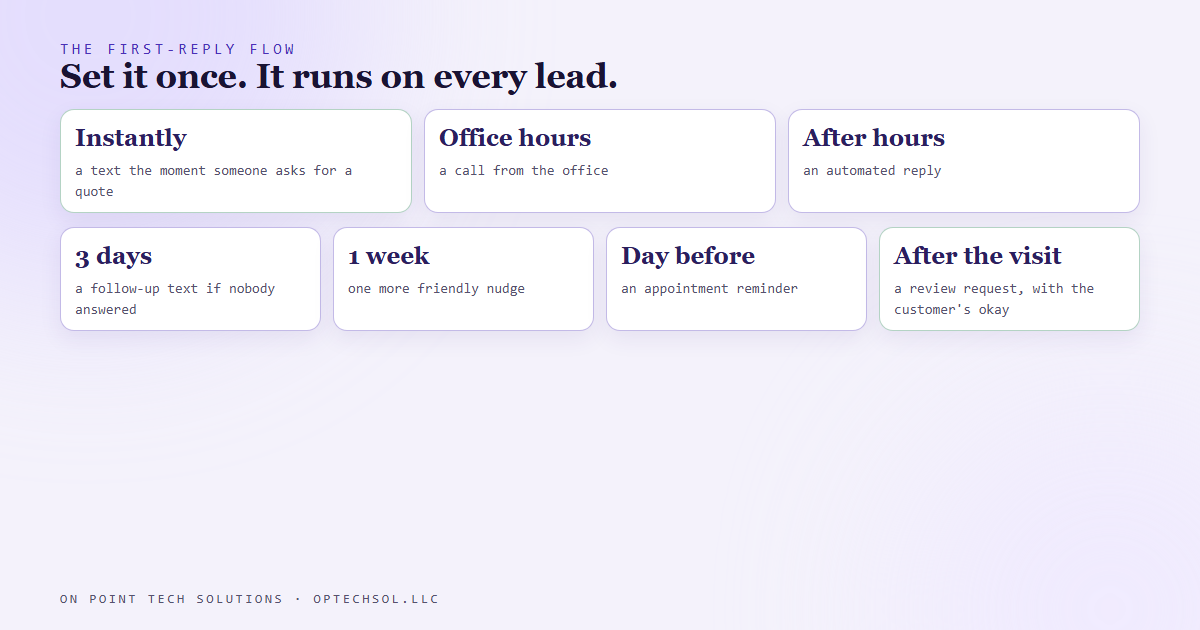
4. The first reply to every lead. The best version we heard went like this: an instant text the moment someone asks for a quote, a call from the office during business hours, an automated reply after hours, a follow-up text at three days and again at a week if nobody answers, a reminder the day before the appointment, and a review request a few days after, with the customer's okay. Set it once and it runs on every lead.
5. One bid request to every sub. When your subs, vendors and suppliers are all in the CRM tagged by trade, you can send one bid request to every electrician at once and get the replies back in one inbox instead of twenty text threads.
What the leaders have in common
The contractors who were furthest along shared a few habits.
They know their lane. A commercial sub who stays commercial. A custom builder with a minimum job size. A remodeler who works one county and doesn't chase jobs outside it. A tight focus makes everything AI touches simpler, because the estimates, the follow-ups and the messaging all look alike.
They write it down first. One operations lead we met was writing step-by-step procedures for the whole shop before choosing any software. That's the right order. AI follows a written process really well. It can't follow one that only lives in the owner's head.
They keep a person in the loop. Every owner who talked about AI and money said the same thing: let it draft and sort, but a human signs off.
They want to own it. Nobody wanted to rent their customer list from a vendor. Owning the system, the data and the logins came up on almost every call.
Your first week with AI as a contractor
- Day 1: List every way a lead reaches you: phone, text, your website form, Google, Facebook, referrals.
- Day 2: Write the first text you want every new lead to get. Short, friendly, with your name and what happens next.
- Day 3: Set the follow-up schedule: three days, one week, the day-before reminder.
- Day 4: Put your real prices in one spreadsheet. That's the file AI will build estimates from later.
- Day 5: Pick one paperwork job, like sorting yesterday's expenses, and try it with AI. Check every line.
Why this matters for San Jose and Bay Area contractors
Leads aren't cheap here, and good crews are booked out. That's exactly why the boring stuff matters. A lead you paid for deserves an answer in minutes, not tomorrow morning. An estimate that goes out the same day beats a better one that goes out next week. And every hour you get back from the books is an hour on the job or at home.
None of the owners we talked to wanted AI to run their company. They wanted it to handle the paperwork so they could build. That's a good goal, and with the right setup for marketing automation in San Jose, it's well within reach for a crew of any size.
Want to learn how to set this up?
Join the On Point Tech Academy at optechsol.llc/academy. It's free, and we build live every Tuesday and Thursday.
The On Point Tech Academy costs nothing and never asks for a card. We build live every Tuesday and Thursday, 12:30 to 1:30 PT.
Join the Academy free ← Back to all Field Notes