
Key takeaways
- Every sound effect in our video library opens with a fraction of a second of silence before the sound actually starts.
- Placing an effect at a moment puts the start of the file there, not the sound, so the effect arrives after the thing it was meant to punctuate.
- Measured per file, the lead-in ran from under two tenths of a second to nearly four tenths. Close enough to feel wrong, small enough that nobody could say why.
- The tell was that turning an effect up never made it feel on time. That means the sound is fine and it is simply somewhere else.
- A second version of the same mistake: effects that were technically in the mix but buried under the music, in a mix whose overall level looked healthy.
We put sound effects into short videos. A sparkle when something cute happens. A whoosh on a hard cut. A tone when a point lands. When they work nobody notices them, which is the point.
For a while ours did not work. Every edit came back feeling slightly off in a way none of us could name. The cut was right. The effect was the right effect. It just did not feel connected to anything.
The instinct, every single time, was that the effect was too quiet. So we turned it up. It got louder and still did not feel connected. That is the moment worth writing down, because that symptom is the whole diagnosis and we did not read it for weeks.
The tool does exactly what you asked
Our video builds place an effect with a file and a timestamp. Put this sound at this second.
What the tool does is put the start of the file at that second. Which is correct, and is not what anyone means. What a person means is "make the sound happen here".
Those are the same thing only if the file starts with sound. None of ours do. Every file in the library we use opens with a stretch of silence first, because that is how these things get exported. So the sound arrives after the moment you aimed at, by whatever the silence happens to be in that particular file.
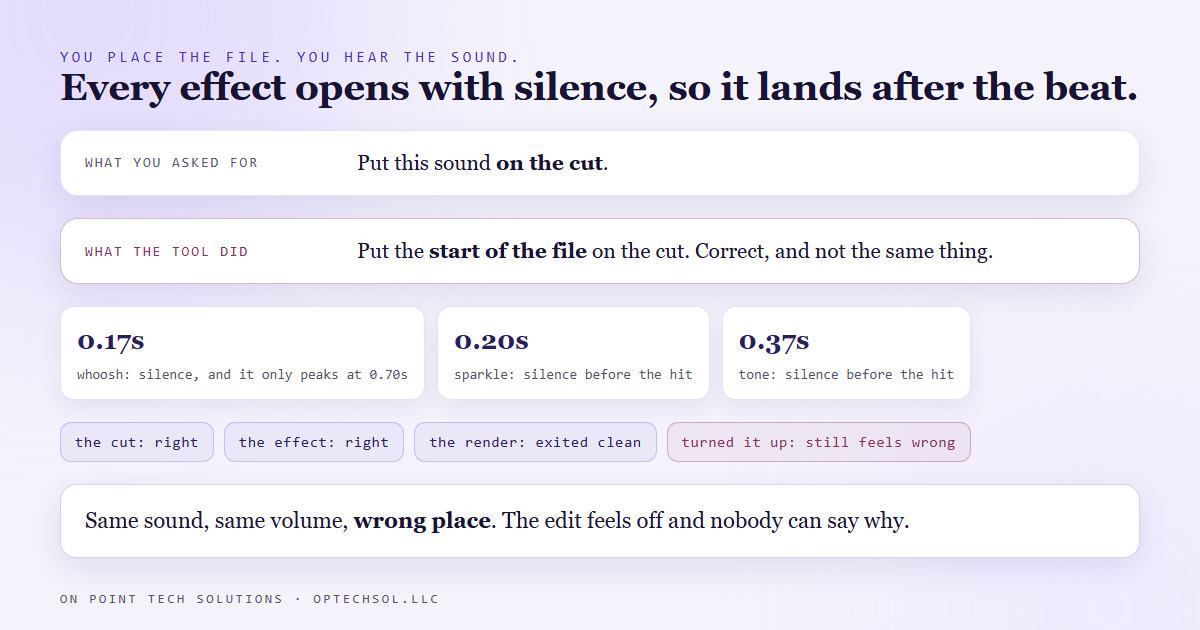
We measured three of the ones we use most. A sparkle had two tenths of a second of silence in front of it. A tone had nearly four tenths. A whoosh had under two tenths before it started, but it is a swell rather than a hit, so its loudest point was seven tenths of a second into the file.
Four tenths of a second is nothing when you say it out loud. On a cut it is enormous. A whoosh meant to crest on a cut instead crests half a second into the next shot, which reads as a mistake even though a viewer could not tell you what the mistake was.
The fix is subtraction, and which number you subtract depends on the sound
The fix is to place the file earlier than the beat by exactly its lead-in. But there are two different numbers, and using the wrong one is its own kind of late.
For a sparkle or a tone, subtract the silence, so the first audible sound is on the frame. That is a hit, and a hit should land on the thing.
For a whoosh, subtract the time to its loudest point instead. A whoosh is not supposed to begin on a cut, it is supposed to peak on one. It is a run-up, and the run-up belongs before.
The second change was measuring instead of guessing. One number for the whole library would be wrong for most of it: the spread across three files was already double. So we measure each file once and use that file's own number.
The same bug wearing a different coat
Fixing the timing exposed a second problem that had been hiding behind it.
We rendered a montage with music and three effects, listened to it, and it sounded fine. Then we rendered the music alone and the effects alone off the same edit and compared them at each beat. Two of the three effects were sitting several decibels under the music at the exact moments they were supposed to be heard.
They were in the file. They were on time now. They were inaudible, because the bed covered them. And nothing about the finished mix looked wrong, because the overall level was healthy. The one loud thing in the mix was just not the thing you wanted to hear.
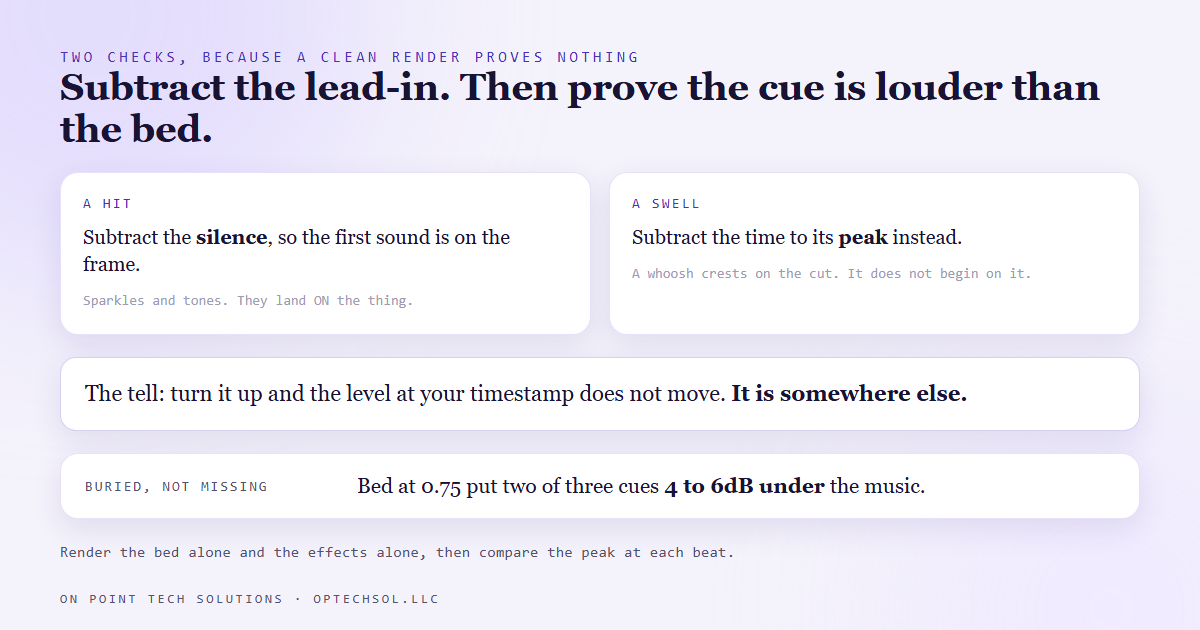
Lowering the bed and lifting the cues put all three above the music at their own moments. What proved it was not a person listening. It was comparing the level at each beat between two separate renders, and a number does not talk itself into hearing something that is not there.
What both of these have in common
A render that finishes without errors tells you the tool ran. It tells you nothing about whether the result does what you wanted, and our build exited cleanly on every one of these edits.
Anything you can only judge by feel will drift, because feel has no record. Once we had a number for the lead-in and a number for the level at each beat, both problems stopped being matters of opinion.
What this means for your business
You are probably not aligning sound effects. You almost certainly have something that runs, reports success, and does not do what you think it does.
The pattern to steal is the tell. When you push harder on a setting and the result does not move, stop pushing. You are adjusting the wrong thing. Turning the volume up on a sound in the wrong place gives you a louder sound in the wrong place, and it will do that all day.
The second half is to have one measurable thing you check after a change, not an impression of it. A confirmation email that sends is not the same as one that arrives. A report that runs is not the same as one with the right rows in it. Pick the number that proves the outcome.
If you are a Go High Level Bay Area business producing your own short video, this one is worth an afternoon. Measure the silence at the front of your effects once, write the numbers down, and every edit after that lands where you put it.
Want this built for you
We build content and automation systems that verify their own output instead of trusting a green light. Start at optechsol.llc.