
Key takeaways
- We automated our Facebook group posting all the way up to the last step, and then deliberately stopped. A human still clicks post.
- The automation writes and schedules. A separate script decides whether anything is allowed to go out at all, and its answer is final.
- The limits live in that script rather than in the writing prompt, because every rate limit is arithmetic over dates, and asking a language model to respect a cooldown gets you compliance most of the time. Most of the time is not a limit.
- Nine groups on a three week cooldown supports about three posts a week, not three a day. On one recent day, three of nine were eligible.
- When a slot has nothing eligible, it stays empty and writes a note about finding a new group. Shortening a cooldown to fill a slot is how an account gets flagged.
Local business groups on Facebook are a real channel. They are also the channel most likely to get you removed, because the people moderating them notice frequency long before they notice content.
So we built the automation, and then we cut the last step off it on purpose.
Why it never posts
Two reasons, and the second one is the serious one.
The first is technical. There is no official way to post into a Facebook group from software. Every scheduler we use tops out at pages. Groups are not on the menu, and that is a deliberate choice by the platform rather than an oversight.
The second is the account. Posting into groups happens as a person, from a personal profile, and that profile is usually the thing that owns everything else. The business page hangs off it. So does the ad account, so does the Instagram, so does the catalogue. An automated browser session driving that profile is an efficient way to lose all of it at once, and there is no support line that gives it back.
So the system writes one short question for one eligible group, three times a day, and puts it on a small local board with a copy button and a link. The words are done. The judgement about whether today is a good day is done. The click is a person's.
The picker decides, the writer only writes
The part worth copying is the split.
A small script owns every rule about whether anything may be posted. It reads a file of groups, a file of limits, and an append only log of every post that has ever actually gone out. Then it answers one question: is anything eligible for this slot, and if so, which group. If the answer is no, nothing gets written.
Only after that does the writing happen, and the writing step is given one job. Write a question for this specific group. It is not asked to check the calendar, count the days since the last post, or remember which groups are on hold.
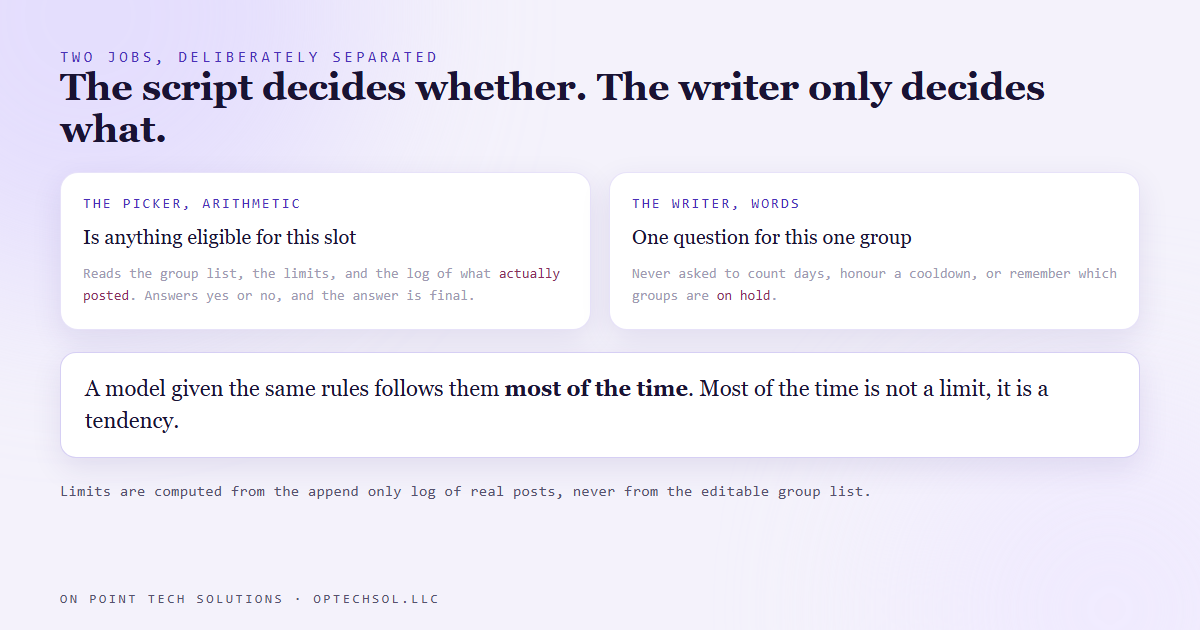
That division exists because the two jobs have different failure modes. Arithmetic over dates is something a script does identically every time. A language model given the same rules will follow them most of the time, and a limit that holds most of the time is not a limit, it is a tendency.
The other detail worth stealing: the limits are calculated from the log of what actually posted, not from the group list. A group record can be edited, corrected, or restored from a backup. The record of what really went out is the only honest input.
The limits, and the one that surprises people
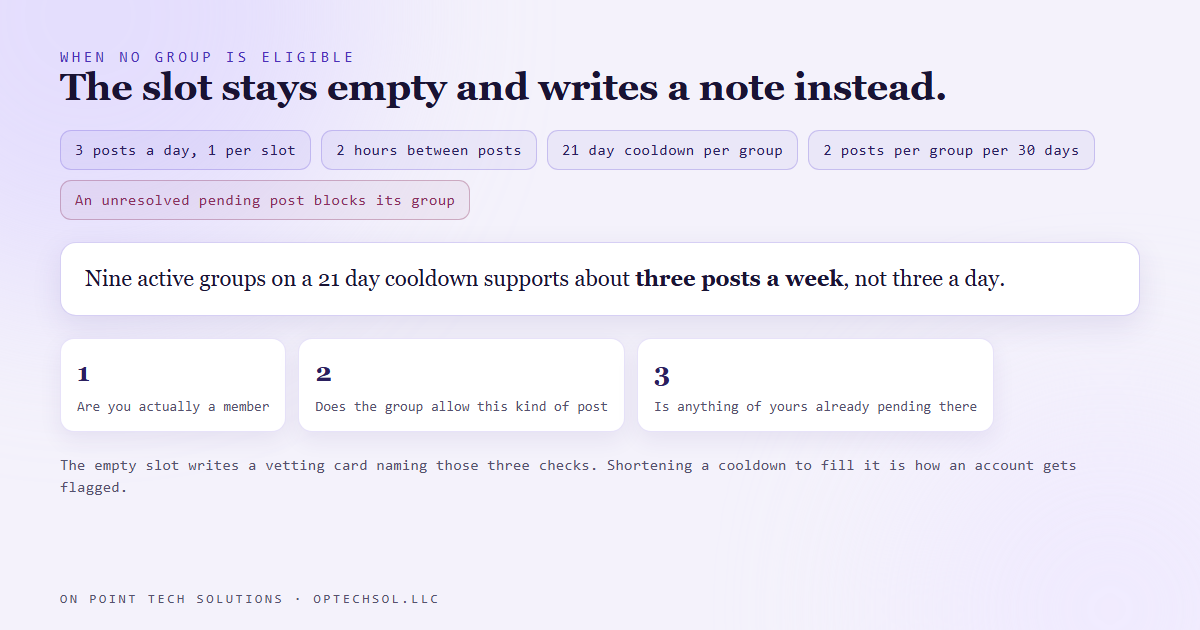
Three posts a day maximum, one per slot, at least two hours apart. Three weeks before the same group can be posted in again, and never more than twice in any thirty day window. Groups where the membership request is still pending are never selected, because those posts sit in a queue forever and stack up. And no repeated text ever, not even a reworded version, because duplicate copy across groups is one of the easiest things for a platform to detect.
The rule that surprises people is this one: if an earlier post in a group is still waiting on moderator approval, that group is blocked entirely.
Two posts pending from the same person is the clearest spam signal a moderator ever sees. It reads as somebody who did not get an answer and posted again, which is exactly what a person clearing a queue is looking for. One group already disqualified itself this way before the rule existed.
What an empty slot does
Here is the honest arithmetic. Nine active groups on a three week cooldown supports roughly three posts a week. Not three a day. On one recent morning only three of the nine were eligible at all.
That is the system working correctly, and it is the moment where most people quietly break their own rules. The slot is empty, the calendar wants content, and shortening one cooldown by a few days would fill it.
Instead, an empty slot writes a vetting card for a group we have never used, naming the three things only a person can check. Are you actually a member. Does the group's own description allow this kind of post. Is anything of yours already sitting in that group's queue. Working through those cards is the only thing that raises the cadence, and it raises it permanently.
The slower and better lever is relationships with the people running the groups. Somebody who moderates a group and knows you has no effective cooldown at all, because you are a participant rather than a poster.
What this means for your business
If you are posting into local groups yourself, the useful move is not more posts. It is separating the decision from the writing. Decide your limits once, in writing, and let something dumb and reliable enforce them. Keep a log of what actually went out and calculate from that log rather than from memory. Never let an empty slot pressure you into shortening a cooldown, and spend that slot recruiting a new group instead.
And be honest about which parts of any channel are safe to automate. This is the kind of judgement call that shapes every marketing automation San Jose owners actually benefit from. Automating the work is easy. Knowing where to stop is the part that keeps the account.
Want this built for you
We build marketing systems for small businesses, including the ones that deliberately leave the last click to a human. Want to build this yourself? Join the On Point Tech Academy. It's free, and we build live every Tuesday and Thursday.
The On Point Tech Academy costs nothing and never asks for a card. We build live every Tuesday and Thursday, 12:30 to 1:30 PT.
Join the Academy free ← Back to all Field Notes