Key takeaways
- Three of our connected social accounts were receiving nothing at all, and nobody had noticed because the posting schedule looked full.
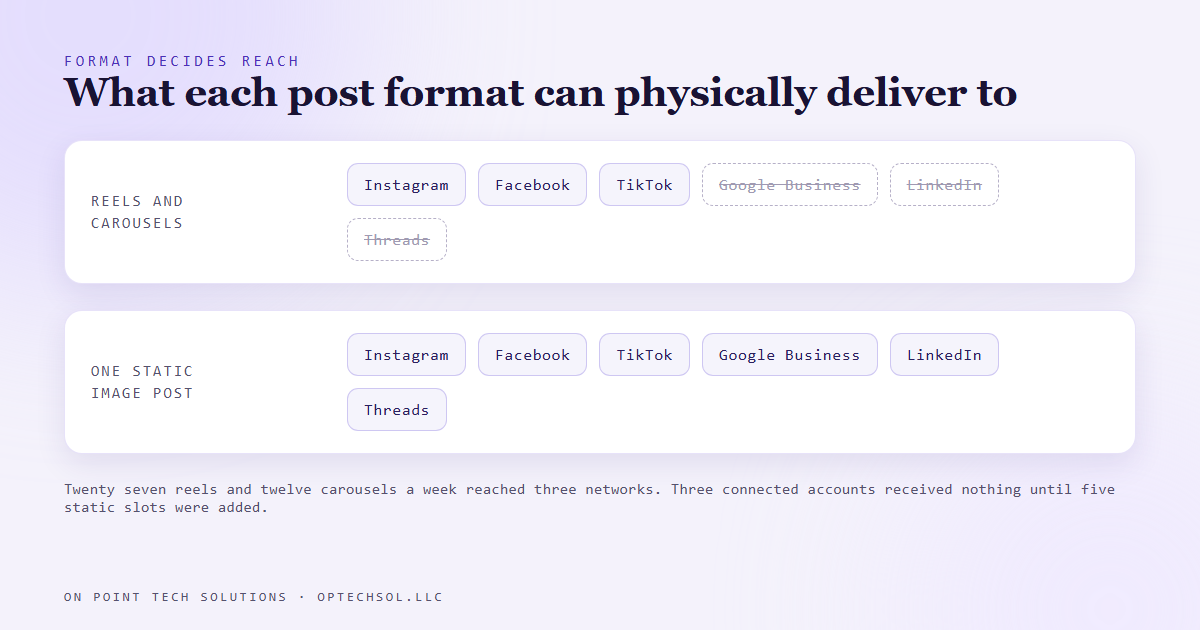
- The cause was format, not effort. Reels and carousels physically route to three networks only. A plain single image is the only thing that reaches the other three.
- So a fifth post type went into the weekly grid, five slots a week, purely to feed the accounts the video slots cannot touch.
- Google Business Profile renders hashtags as literal text, so those posts carry none.
- Audit what each format can physically reach before you audit how much you are posting.
Our own social accounts run on a schedule, not on motivation. Eight or nine posts a day, sixty slots a week, built the night before and fired at the slot time. Twenty seven reels, twelve carousels, sixteen stories.
For weeks that looked healthy. The grid was full, the queue was full, nothing was failing. Then somebody actually opened Google Business Profile.
Three accounts, connected, receiving nothing
Google Business Profile, LinkedIn and Threads were all connected to the account. All three had been connected for a long time. All three had received exactly zero posts from the machine.
There was no error. Nothing had broken. The posting script was doing precisely what it was built to do, which was route each item to the networks that can actually accept that format. A vertical video goes to Instagram, Facebook and TikTok. A carousel goes to the same three. Those are the networks with the capability, so those are the networks that get the post.
The other three do not take a reel through that path. So the busier the video schedule got, the more completely they were ignored. A full calendar and three silent accounts, at the same time, for the same reason.
The fix was a fifth post type, not more content
The obvious answer is to make more content. The right answer was to add one format we were not making at all.
A plain single image post is the lowest effort thing in the whole system and the only one that lands everywhere. So the weekly grid got a new kind. Five slots a week, spread Monday, Tuesday, Wednesday, Friday and Saturday, all of them in the afternoon. Every one carries a static image and a caption, and every one reaches all six networks instead of three.
Those five slots draw from the one lane in the whole system that actually sells, which is the tap to review card in our shop. That was deliberate. If a format is going to reach the two most professional networks we are on, the thing it carries should be the product, not a mood board.
It also solved a second problem we already had. There were forty four approved product videos sitting in a folder that had been posted zero times, plus a handful of statics nobody had used. The new slots gave the statics somewhere to go.
Two things that only show up once you post there
Google Business Profile does not understand hashtags. It renders them as literal text in the body of the post, so a caption that ends with three tags looks like somebody left their notes in. Those slots now carry zero hashtags, on purpose.
That sounds like a small formatting note. It is actually a constraint that reaches back up into the pipeline, because our posting script sends one caption string to every network on the item. There is no per network variant. So a post going to six places has to be written so it is safe in all six, or it has to be split into separate items per network group.
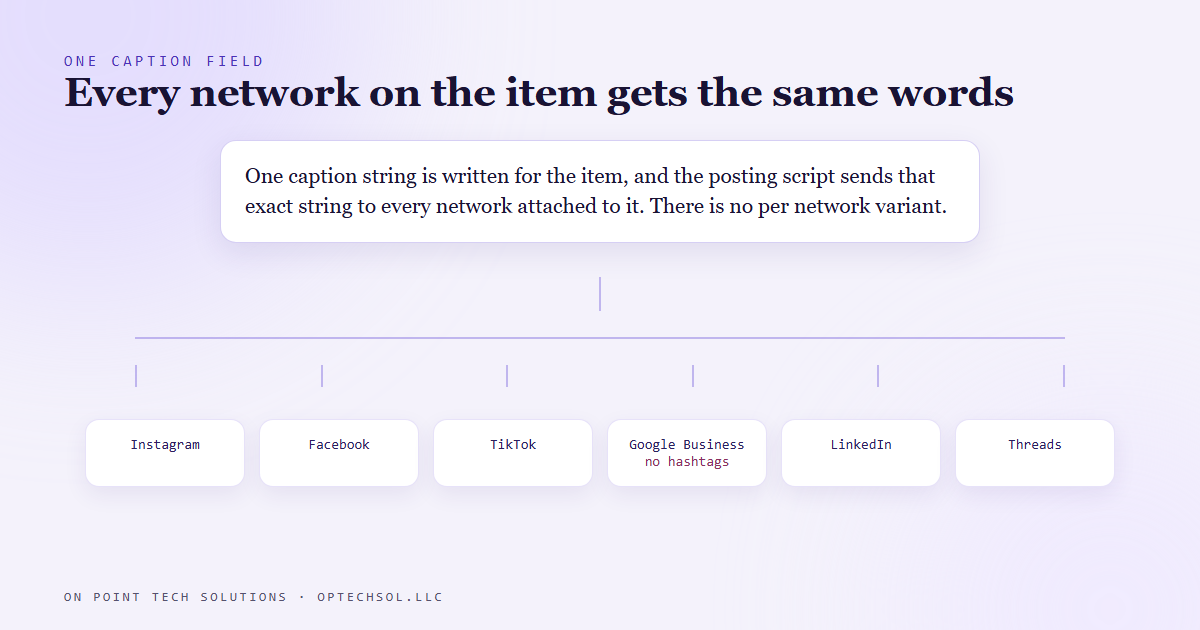
We picked one caption that works everywhere and wrote down the limitation instead of pretending it was a choice. That is worth saying plainly. The system has a known gap, it is logged, and nobody has decided yet whether the fix is worth the complexity. A logged gap you can act on later beats a quiet workaround that gets forgotten.
The percentage is capped on purpose
The selling lane sits at roughly twelve percent of the weekly mix and it is not allowed to creep. Every content teardown worth reading says the same thing. The pillar with a conversion mechanism attached gets less reach than the craft pillars, sometimes five or ten times less, and you run it anyway because it is the one that produces money.
The trap is letting it grow because it is the only lane you can measure. Then the reach on everything drops, the selling posts land in front of fewer people, and the thing you optimised for gets worse. Cap it, and defend the cap.
Slot times themselves are never typed by hand. They come out of a grid file, and a verify command checks the weekly totals, the spacing between video posts, duplicate times, and any slot whose lane is not declared. Hand editing a time is how a schedule drifts for a month without anyone seeing it.
What this means for marketing automation San Jose businesses
Almost every local business we look at has this shape of problem somewhere. Not a lack of effort, a mismatch between the format they are producing and the places they think they are reaching.
Three things worth checking this week:
- Open every connected account and look at the last post date. Not the scheduler, the actual profile. A tool reporting success and a profile with nothing on it are completely compatible.
- Write down which formats each network accepts. Then compare that to what you actually make. If you only make video, you are only reaching video networks, no matter how much of it you make.
- Make the cheapest format you are missing. For most local businesses that is one decent photo with a caption. It is the format that reaches Google Business Profile, and Google Business Profile is the one your customers search first.
The honest lesson from this build is that a full calendar is not evidence of reach. We had one, and three accounts still had nothing on them. The audit that fixed it took twenty minutes and cost nothing, and it was not an audit of the content. It was an audit of what the formats can physically do.
If your posting looks busy and your Google profile looks abandoned, that gap is fixable and it is most of what we do. Want to build this yourself? Join the On Point Tech Academy. It's free, and we build live every Tuesday and Thursday.
The On Point Tech Academy costs nothing and never asks for a card. We build live every Tuesday and Thursday, 12:30 to 1:30 PT.
Join the Academy free ← Back to all Field Notes