Key takeaways
- Every CRM walkthrough we tried to film had a real client name somewhere in the frame.
- A name lands in at least five regions of a single screen, so there is no clean crop and no safe zoom.
- The fix was a second CRM account holding nothing but fiction: invented businesses, reserved phone numbers, example.com addresses.
- It copies the real twenty two stage pipeline exactly, because a demo that does not match the live system teaches the wrong habits.
- The seeded data is deliberately imperfect, because the lessons are about what goes wrong.
We film a lot of screen recordings. Course lessons, sales demos, walkthroughs for a client who wants to see how their own system works. Every one of them means opening the CRM and pointing at things.
And every one of them had the same problem. Real client names were on the screen.
You cannot crop your way out of it
The first instinct is to zoom in on whatever you are demonstrating and call it handled. That does not survive contact with an actual recording.
Open one contact record and count where a name appears. It is in the left sidebar, in the list sitting behind the panel you are pointing at. It is in the header of the record itself, next to the phone number. It is in the notification that slides in when somebody texts you halfway through your take. It is on the pipeline board, on every card in every stage at once. And it is in the browser tab, which nobody remembers to check until the video is already published.
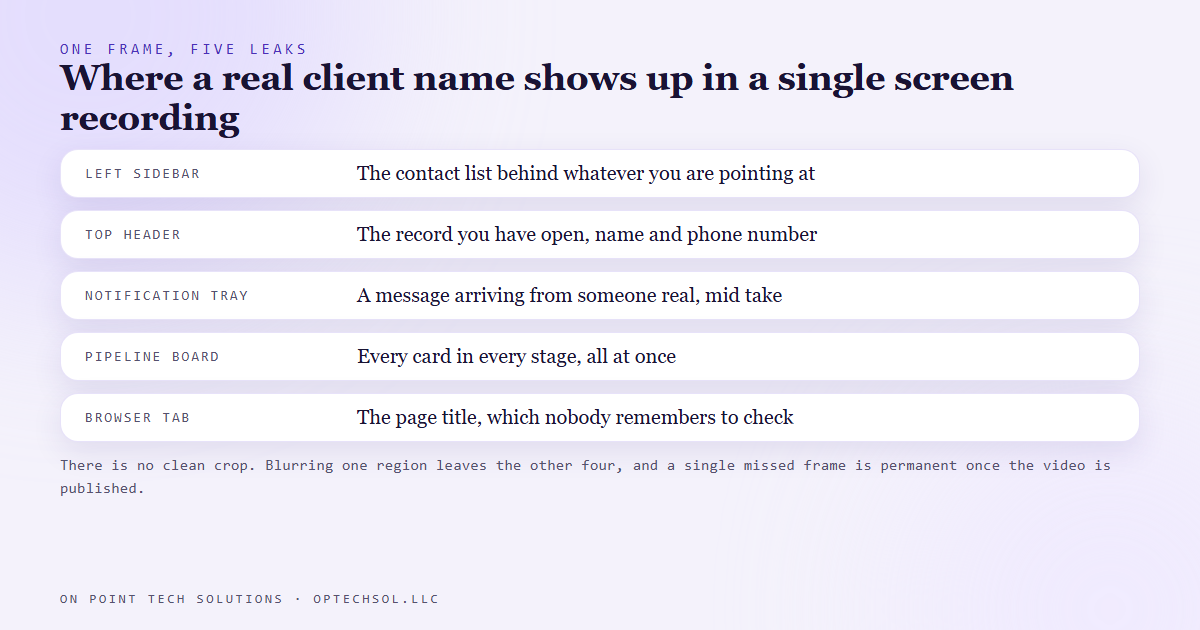
That is five regions in one frame, and they move. Blurring the sidebar does nothing when the header is fine and the tray is not. Cleaning it up afterwards means tracking a mask across a moving screen for ten minutes, per video, forever.
It is also the wrong shape of work. You end up spending editing time defending against a mistake instead of removing the chance to make it.
A second account that holds nothing real
So we built one. A separate CRM account under the same agency, named for training, that has never held a real person.
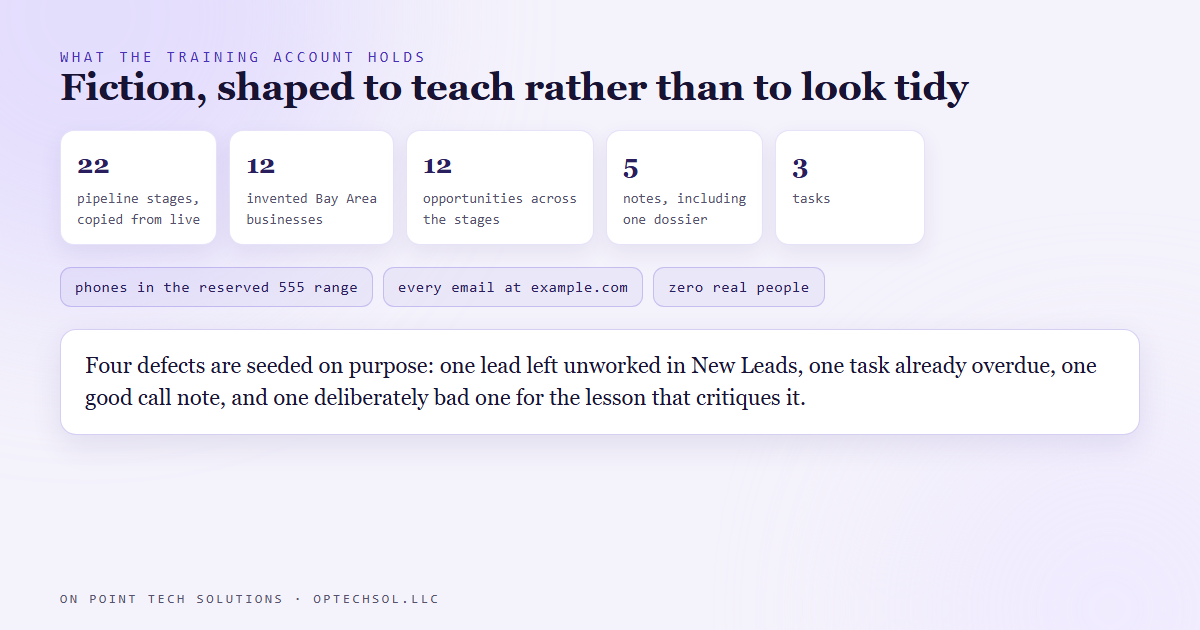
Every business in it is invented. Every phone number sits in the 555 range reserved for fiction, so if somebody pauses the video and dials it they reach nothing. Every email address ends in example.com, which exists for exactly this. There is no scenario where a viewer finds a real customer in a frame, because there is no real customer in the account.
That is the whole point. The safety is not in careful editing. It is in the fact that the source material cannot leak, so nobody has to be careful.
It has to match the real thing
The temptation with a demo account is to build a tidy simplified version. Five clean pipeline stages instead of twenty two. Three contacts instead of a full board.
We copied the real pipeline verbatim instead. All twenty two stages, in order, with the real stage names. New Leads through Dialing, Contacted and Callback Set, all the way out to Project Complete and Lost.
The reason is muscle memory. Somebody watches the lesson, learns where things sit, then opens the live account and finds a board that looks nothing like the one they were taught on. Now they are relearning it under pressure, on a real lead. A demo that is easier than the real system is not a shortcut. It is a second thing to learn.
The data is bad on purpose
Twelve invented Bay Area businesses. Twelve opportunities spread across the stages. Five notes and three tasks.
Small numbers, and shaped rather than sprinkled. One contact carries a full pre call research write up in exactly the format our own research automation produces, because one lesson is about reading one. Another carries a good five line call note. A third carries a bad one, the note the lesson picks apart.
One lead is left sitting unworked in New Leads. One task is already overdue.
Both of those look like mistakes if you glance at the account. They are the lesson. A large share of what goes wrong in a pipeline is leads quietly rotting in the first stage and follow ups slipping past their date, and you cannot teach either one on a board where everything is clean.
What this means if you run a business here
Most owners we talk to in San Jose and around Los Gatos are not filming courses. Two things here still apply directly.
The first is the recording rule. If you ever screen share your CRM on a sales call, post a screenshot in a Facebook group, or send a quick video to a contractor, your customer list is in that frame. Nobody sets out to publish it. It goes out sideways, in the background of something else.
The second is the sandbox itself, and it is cheap. A copy of your system seeded with fake customers is where you train a new hire, test an automation before it touches real people, and record anything you plan to share. Break it as often as you like.
The rule underneath both: do not depend on remembering. Any process that only works when somebody remembers to blur, redact or double check will fail on the day they are in a hurry. Build the version where the mistake is not available.
Want this built for you
We build Go High Level systems for San Jose and Bay Area businesses, including the training and sandbox setup that keeps your customer data out of your own videos. Want to build this yourself? Join the On Point Tech Academy. It's free, and we build live every Tuesday and Thursday.
The On Point Tech Academy costs nothing and never asks for a card. We build live every Tuesday and Thursday, 12:30 to 1:30 PT.
Join the Academy free ← Back to all Field Notes