
Key takeaways
- Every long form video we built carried the same fixed music gain, copied from build to build, and nobody had ever measured what it produced.
- Measured on one video, the voice sat only 6.6 loudness units above the music. Narration wants roughly 15 to 20.
- A fixed multiplier can never be right, because every music track has its own loudness, so one number lands somewhere different on every track.
- The build now measures the voice, measures the music, and solves for the gain that puts the music a stated 16 units underneath. It verified at exactly 16.0.
- Replace a setting you nudge until it sounds right with a measurement you can say out loud.
Michael watched the first cut of a long tutorial we had just finished and sent back one line. The background music can be turned down, it is kind of loud and overpowering.
Fair note. The easy version of this job is to open that one project, make the music number smaller, render again, move on. So the question back was whether he wanted it fixed on that video or fixed everywhere. Every build.
The number nobody had ever checked
Each video is described by a build file, and that file had a line setting the music to a fraction of its original volume. Fifteen or sixteen percent. That value was typed once, long ago, then copied into the next project and the one after that, the way most settings get their values.
So we measured it, with the loudness meter that ships with the same tool that does the mixing. The voice came out at minus 23.5 on the standard loudness scale. The music, measured all the way through its own processing including the part that automatically dips it under speech, came out at minus 30.1. The gap between them was 6.6 loudness units.
Music sitting under narration wants roughly 15 to 20 units of separation. We were at less than half the bottom of that range, and it had already shipped on other videos the same way.
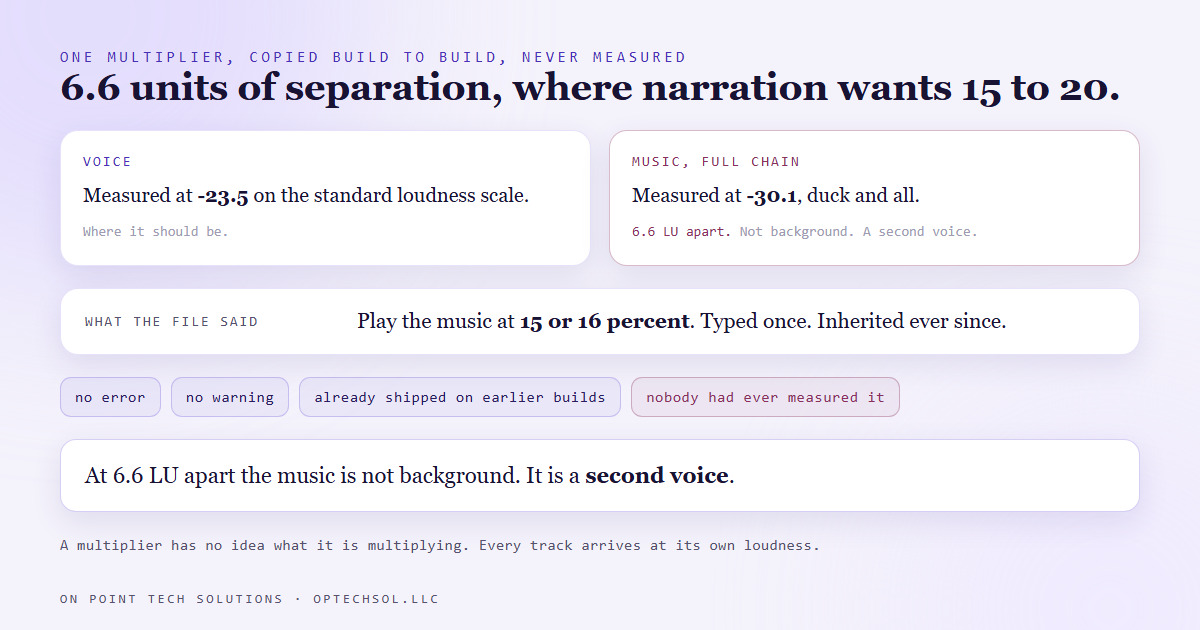
Worth saying what that gap means. At 6.6 units apart the music is not background, it is a second voice. Listeners rarely say the music is too loud. They say they cannot concentrate, or they leave two minutes in and could not tell you why.
Why a smaller number would have been the wrong fix
The obvious move is to change fifteen percent to eight percent and be done. We nearly did. It is wrong because the setting is a multiplier, and a multiplier has no idea what it is multiplying.
Music tracks are not recorded at the same level. A sparse piano bed and a dense loop with drums under it can differ by ten units before anything touches them. Cut both to the same fraction and you get two different results, and picking a better fraction does not fix it, because the next track will be different again. That is the real defect. A number was being used to answer a question about a relationship.
What the build does now
Three steps, all automatic, on every video. It measures the finished voice track. It measures the music through its own processing chain at full volume, so the measurement includes the dip and everything else that will happen to it. Then it solves for the one multiplier that puts the music a stated number of units under the voice. The default is 16.
The stated number is the part that matters. The build file no longer holds a volume. It holds a separation, which is a claim anyone can check by measuring the output. There is still an escape hatch for a project that needs a literal multiplier, and an old file carrying the old volume key gets it ignored on purpose, with a line in the log saying so, so an inherited value cannot quietly override the fix.
We removed that old key from all seven project files so they would pick up the new behaviour. On the next render the solver computed about five percent, and the music measured minus 39.5 against a minus 23.5 voice. Exactly 16.0 units.
One measurement is enough, and that is not obvious
You might expect this to need a loop. Set a gain, measure, adjust, measure again. It does not, and the reason is worth understanding if you build anything like it.
The automatic dip that pulls the music under speech is keyed to the voice, not to the music. So how hard it ducks does not depend on how loud the music was to begin with, which means the music level moves in a straight line with the multiplier.
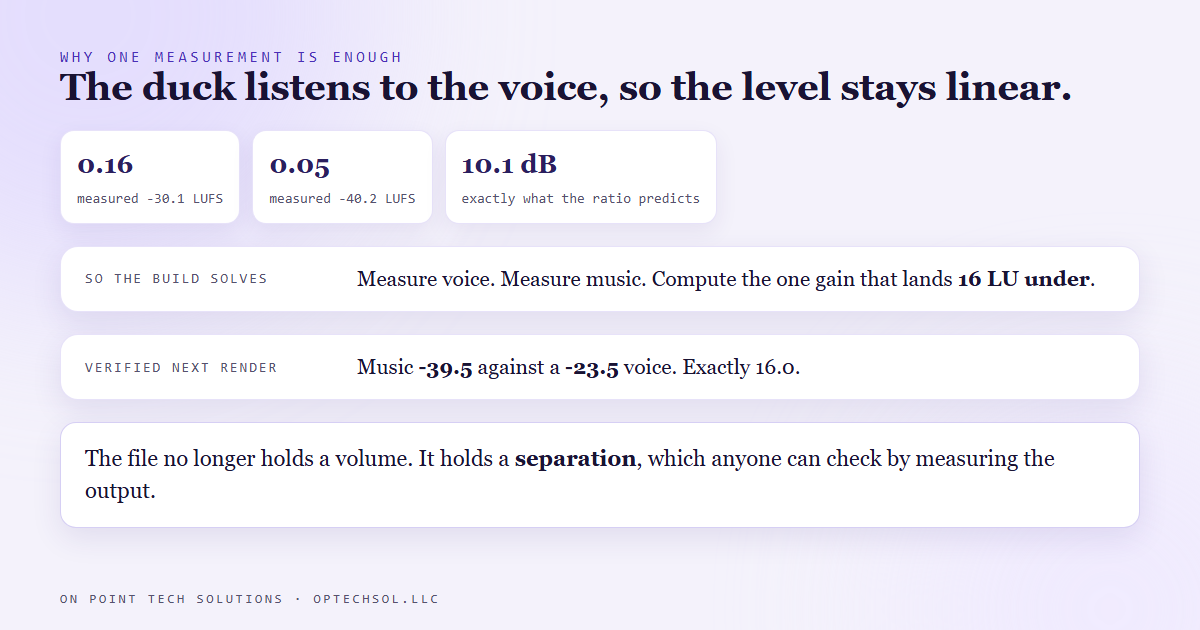
We proved it rather than assuming it. A multiplier of 0.16 measured minus 30.1, and 0.05 measured minus 40.2. That is a difference of 10.1 decibels, which is exactly what the ratio between those two numbers predicts. Linear. So one measurement solves it in one pass.
One worry came up immediately, and it is the right one. If the music drops that far, does the whole video get quiet? No. The finished mix is normalised to a target loudness afterwards, so the headroom gets spent on the voice instead. Same overall level, clearer narration.
What this means for your business
You almost certainly have settings like that fifteen percent. A send delay somebody picked in a hurry. A lead score threshold copied from a template. A follow up that fires after three days because three is a nice number. None are wrong on purpose. They were typed once by somebody solving a different problem and inherited ever since.
The useful question is not whether each is right. It is which of them state a number where they should state a relationship. A volume is a number. Sixteen units under the voice is a relationship, and a relationship can be verified.
Three things worth doing this week. Find the settings that got copied in rather than chosen, and write down where each value came from. For the ones that matter, ask what outcome the number is meant to produce, and whether the system could measure that outcome itself. And when you change one, measure the result rather than trusting that it felt better.
For a Go High Level San Jose business running automated follow up, this usually shows up in timing. Nobody can tell you why the second text goes out at 48 hours. Make the system state the goal, then check the goal.
Want this built for you
We build content and automation systems whose settings state what they are trying to achieve, and then prove it. Start at optechsol.llc.