Key takeaways
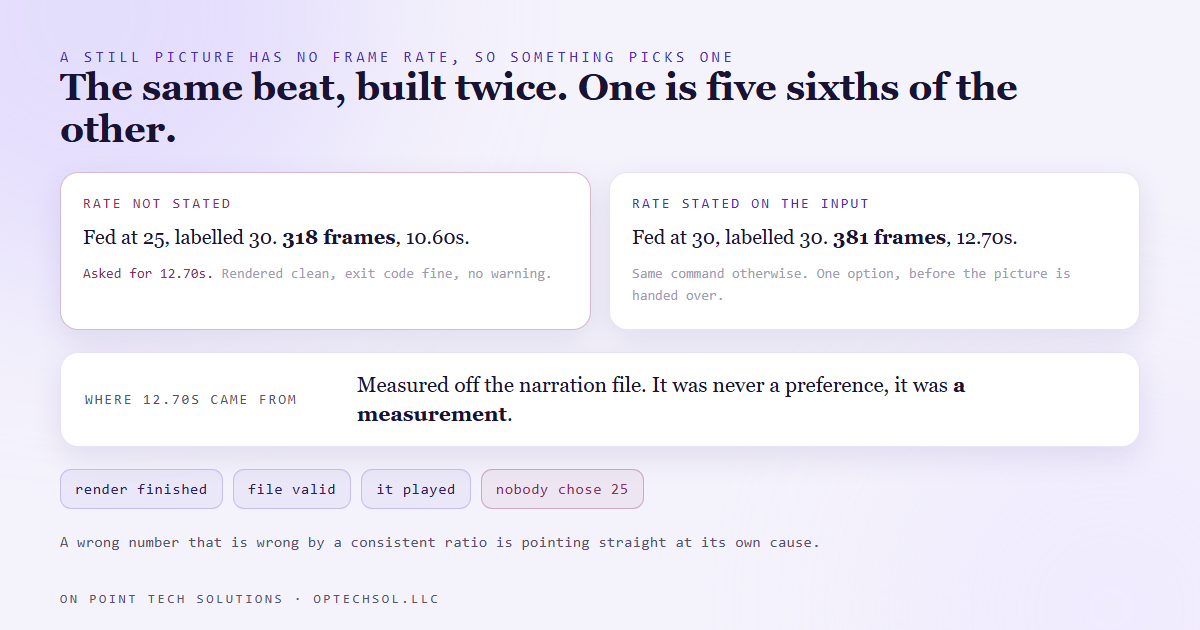
- A shot we asked for at 12.70 seconds rendered at 10.60. Exactly five sixths, on every clip, because a missing setting on the input made the tool guess.
- The guess is the tool's default, not an error. It fed the still picture at one rate while labelling the finished clip with another, and never said a word.
- A fifth off each clip would be survivable on its own. The clips are joined by crossfades whose timings are worked out from those durations, so every join landed past the end of the clip it was joining.
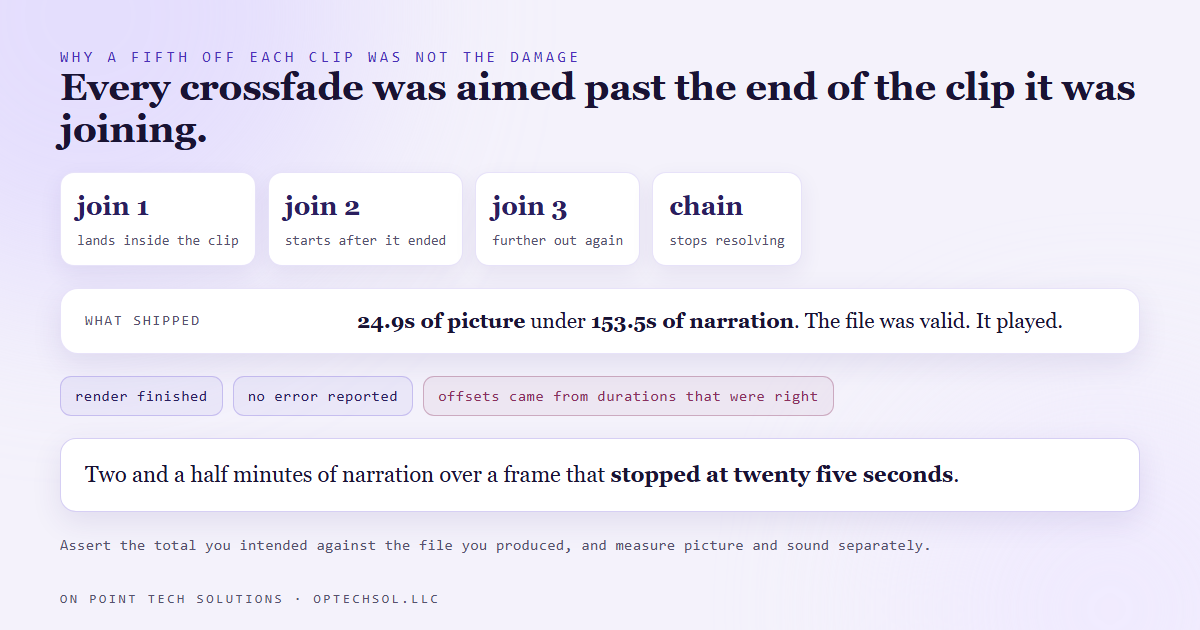
- The whole video then collapsed into its first transition. The finished file held 24.9 seconds of picture against 153.5 seconds of narration, and the tool reported no problem at all.
- The fix is one option in one place. The habit worth keeping is measuring the finished file rather than trusting the numbers you asked for.
We build training videos out of still frames and narration. Each beat is a picture held for as long as that piece of the voiceover takes, with a slow push on it, and the beats are joined with short dissolves. Simple, repeatable, and the durations come from measuring the audio rather than from anybody guessing.
So when a beat says 12.70 seconds, that number came from the narration file itself. It is not a preference. It is a measurement.
The clip came out at 10.60 seconds.
Five sixths, every time
A wrong number that is wrong by a consistent ratio is a gift, because it tells you the cause is arithmetic rather than something random. 10.60 against 12.70 is close to five sixths, and five sixths is twenty five over thirty.
Those are frame rates. The finished video is thirty frames a second. Twenty five is what the tool feeds a still picture when nobody tells it otherwise.
So the still was being supplied at twenty five frames a second, the output was being labelled thirty, and the clip ended up holding exactly the number of frames the input had handed over. Three hundred and eighteen of them, which at thirty a second is 10.60 seconds. The maths is perfect. The only wrong thing is that nobody chose twenty five.
Worth sitting with what that default is. It is not a fallback for a broken input and it signals no problem. A still image genuinely has no frame rate of its own, so something has to pick one, and the tool picks a sensible historical number and gets on with it. Silently, because from its side nothing went wrong.
Why a fifth off was not the real damage
Losing a fifth of each clip is bad and you would eventually notice, probably by the narration running past the picture. That is not what happened, and this is the part that makes the story worth telling.
The clips are joined with crossfades. A crossfade needs to be told when to start, and that offset is worked out by adding up the durations of everything before it. Those durations came from the narration, and the narration was correct.
So every offset was calculated against a clip a fifth longer than the clip that actually existed. The first join was fine. The second started after its clip had already ended. The third was further out, and so on down the chain, each one missing by more than the last.
The result is not an error. The chain simply stops resolving and the finished file carries the first transition and nothing after it. We ended up with a video holding 24.9 seconds of picture against 153.5 seconds of narration. Two and a half minutes of somebody talking over a frame that stopped moving twenty five seconds in.
Nothing anywhere reported a fault. The render finished, the file was valid, it played.
The fix, and the check that outlasts it
The fix is one option, stated on the input rather than the output, before the picture is handed over. State the frame rate and the beat renders at 381 frames, which is 12.70 seconds, which is what was asked for. The comment above that line in our build now explains the whole story, because it is exactly the sort of line somebody tidies away later for looking redundant.
The check matters more than the fix. Two of them, and they are cheap.
Add up the durations you intended, measure the duration of the file you actually produced, and refuse to continue if they disagree. And measure the picture and the sound separately, because a file with the right total length can still be a still frame under a voice. Our build does both now, and neither takes a second to run.
The pattern, which is the point
A default is a decision somebody else made for you, on a day they did not know what you were building. Most are harmless. The dangerous ones share two properties: they are silent, and they are close enough to right that the output still looks plausible.
Ours was both. Nothing warned us, and a clip a fifth short is still a clip. If it had produced a zero second file or a crash, we would have found it in a minute.
What this means for your business
The same shape runs through the software you actually use. A time zone that defaults to wherever the server is, so appointment reminders land an hour out. A currency that defaults to the account's setting rather than the customer's. A follow up that defaults to sending immediately because nobody set a delay. A file upload that silently shrinks images past a size.
In each case nothing errors, because from the software's side nothing has gone wrong. It filled a blank you left.
Three things worth doing this week. For any automation that matters, list the settings you never explicitly chose, because those are the ones something else chose for you. Make anything automated check its own output against what it was asked to produce, even crudely, since a total that does not match is the cheapest alarm there is. And when a number comes out wrong by a consistent ratio rather than randomly, chase the ratio, because it is almost always pointing straight at the cause.
For a Go High Level San Jose business, the one to check today is your appointment and reminder timings against the time zone on the account rather than the one in your head. It is the most common version of this we see, and nothing in the system will ever tell you.
Want this built for you
We build content and automation systems that state their settings out loud and verify their own output. Start at optechsol.llc.