Key takeaways
- Every morning we build a shoot list from how competitor videos are performing, and for that we were paying a scraper to pull their numbers.
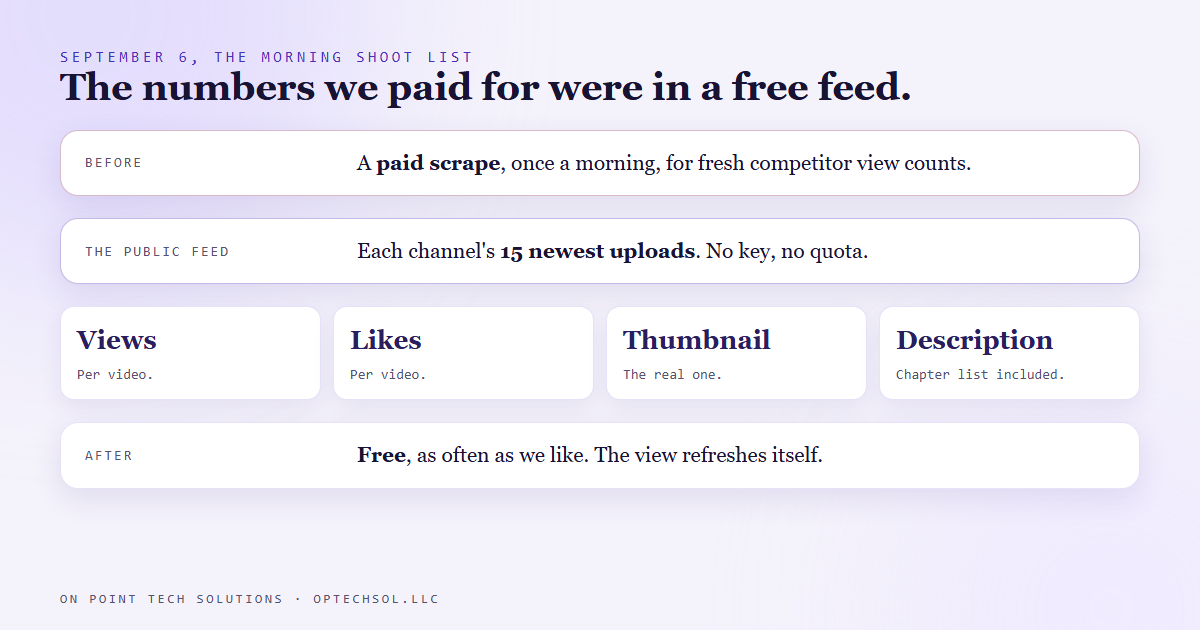
- On September 6 we found that each YouTube channel's public feed already carries its 15 newest uploads with view counts, like counts, thumbnails and full descriptions, chapter lists included. No key, no quota, no paid scrape.
- The daily check went from a paid run once a morning to free, as often as we like. That is what made a dashboard that refreshes itself possible at all.
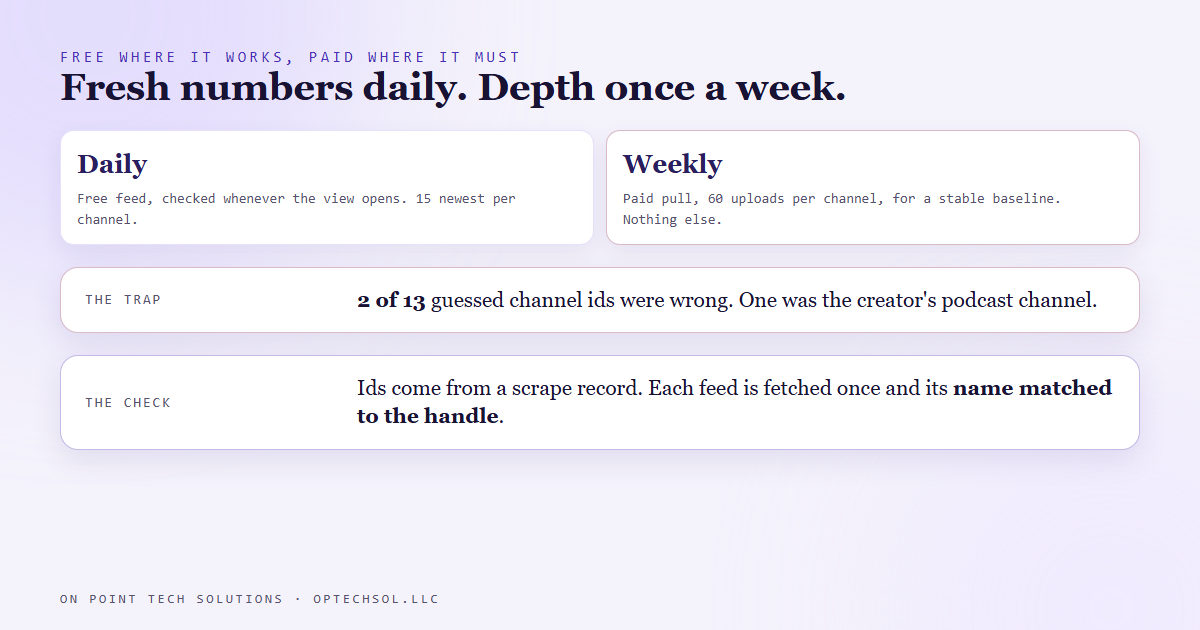
- The free feed did not replace everything. Fifteen videos cannot give a stable average, so the paid pull still runs once a week for a deeper baseline and nothing else.
- Two of the thirteen channel ids we first guessed were wrong, one pointing at the creator's podcast channel. Every feed now gets fetched once and its name checked before we trust it.
Before you pay for data, ask one boring question: what does the free, public version already give me? We do marketing automation in San Jose, and we skipped that question for a while. We were paying every morning for numbers that were sitting in a public feed the whole time.
What the morning shoot list needs
Every morning a job in our command center ranks five video ideas for me to shoot that day. Part of how it ranks them is by watching a list of thirteen channels in our space and spotting the videos that are doing better than that channel usually does. A video pulling far more than its channel's normal views is telling you something about the topic, not just the creator.
To do that math you need two things: fresh view counts on new videos, and a sense of what normal looks like for each channel. We were getting both from a paid scraping service, once a morning.
What we found on September 6
While building the morning list into its own view, we opened the plain public feed that every YouTube channel has. Most people know it as the thing old feed readers used to subscribe to. We expected titles and links.
It carries a lot more. For each of a channel's 15 newest uploads it has the view count, the like count, the thumbnail and the full description. The full description includes the chapter list, so you can even see how a creator structured the video. No account, no key, no daily quota.
Every number the daily check was paying for was right there.
What changed once it was free
The obvious change is cost. The daily pass stopped costing anything.
The bigger change was frequency. When every check costs money, you check once a morning and live with stale numbers all day. When it costs nothing, you can check whenever you open the screen. Our shoot list view now refreshes its numbers whenever they are more than 15 minutes old, and the open view polls every few minutes. That self refreshing view was not a feature we had planned. It only became possible because the data became free.
What the free feed could not do
The honest part is that we did not get to cancel everything. Fifteen videos is not enough to know what normal looks like for a channel. One viral upload in a set of fifteen throws the whole average off.
So the paid pull still runs, once a week instead of every day, for one job: grabbing the last 60 uploads per channel to set each channel's baseline. The daily view uses the free feed for fresh numbers and compares them against that weekly baseline, so the only thing we still pay for is the depth.
The trap: the wrong channel looks exactly like the right one
The feed needs the channel's real id, a long code, not the handle you see on the page. When we first set it up we looked a few of those ids up by searching, and two of thirteen were wrong. One of them pointed at the creator's podcast channel instead of their main one.
A wrong id does not error. It returns a perfectly good feed for a different channel, and the numbers look just as real. So now every id comes from a scrape record, not a search, and every feed gets fetched once and its channel name checked against the handle before it is allowed into the list.
What this means for San Jose businesses
You are probably paying for something like this right now. A report from a vendor that restates numbers already on a public page. A monthly review tool that tells you your star rating, which your own listing shows for free. A ranking report you could mostly read off a search. Some of those are worth it because they add history or depth. Some are just a nicer screen on free data.
- List every data service you pay for, and next to each one write where that number publicly lives, if anywhere.
- Split the job. Fresh daily numbers often come free. Long history and deep comparisons are usually where paying makes sense.
- When you switch to a free source, check that it is pointing at the right thing. A wrong source fails quietly and looks just as believable.
That is where I would start any marketing automation project in San Jose: figure out what a business already has access to, then pay only for the part it cannot get any other way.
Want to build this yourself?
Join the On Point Tech Academy at optechsol.llc/academy. It's free, and we build live every Tuesday and Thursday.
The On Point Tech Academy costs nothing and never asks for a card. We build live every Tuesday and Thursday, 12:30 to 1:30 PT.
Join the Academy free ← Back to all Field Notes