Key takeaways
- Our brand guide bans the long dash. Our AI assistant used it constantly, at customers, for about a year.
- The prompt told it not to. The prompt was also written in prose full of them, and the model copied what it saw rather than what it was told.
- An AI agent treats its own instructions as a writing sample. Style is caught from the document, not obeyed from the sentence.
- Both prompts now carry an explicit formatting block, and the surrounding prose obeys the same rule.
- The push script refuses to upload a prompt file containing either character. A rule a tool enforces beats a rule somebody remembers.
We have a small, unglamorous brand rule. No em dashes, no en dashes, anywhere a customer can read. It comes from Michael's own writing, which is short sentences and plain words, and the long dash makes text look like it was assembled rather than said.
Our text and email assistant broke that rule in nearly every message it sent, for roughly a year, to actual customers.
Telling it was not enough
The obvious theory is that nobody told the bot. Somebody did. The instruction was in the prompt.
Here is what was actually happening. The prompt itself, the several hundred words describing who the assistant is and how it should behave, was written in ordinary prose by people who write with dashes. So the document said do not use these, in a paragraph that used four of them.
The model did what models do. It read the whole page and picked up the register of the page. An instruction is one sentence competing against every other sentence in the document, and the other sentences win, because they are demonstrating rather than describing.
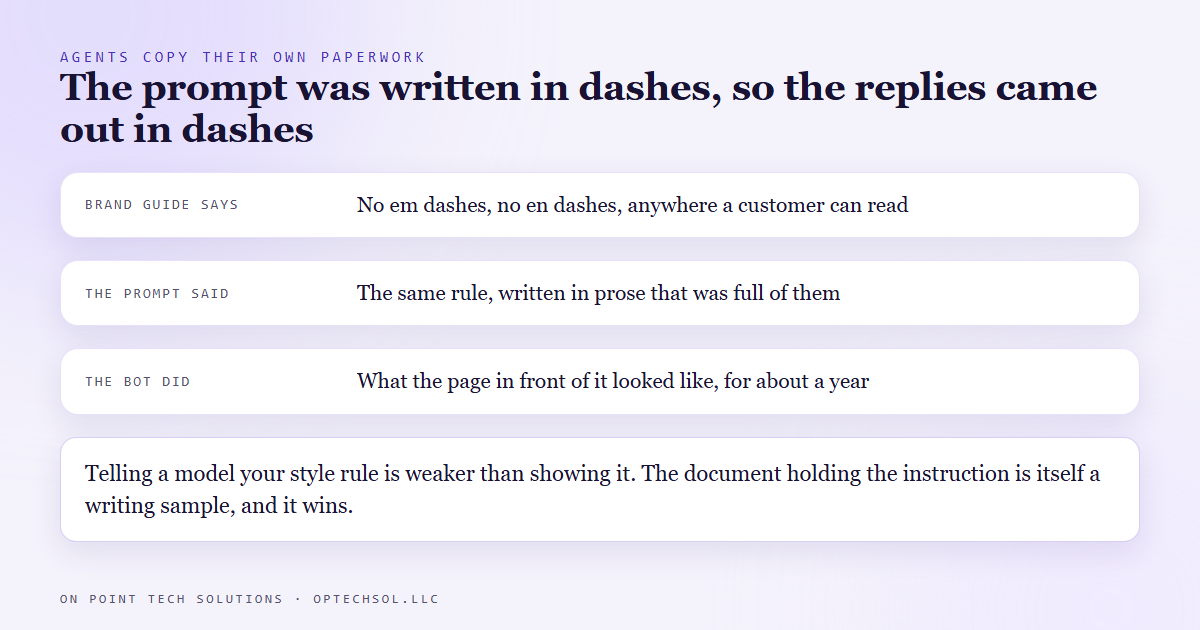
Once you see it, you see it everywhere. Ask an assistant to be concise in three long rambling paragraphs and you will get long rambling answers. Ask it to be casual in stiff corporate language and it will be stiff. The instruction document is a sample of the writing you are asking for, whether you meant it to be or not.
That is the real finding here, and it is bigger than punctuation. When you write a prompt, you are not only giving orders. You are showing the model a piece of writing and implicitly saying, this is the kind of text that belongs in this situation.
Why a year
The uncomfortable question is how something that visible ran that long.
Because it looked fine. Every message the assistant sent was polite, on topic, and helpful. Nobody reading a reply thinks about punctuation. The rule lived in a brand document that humans consult when they write, and the assistant is not a human who consults documents, so nothing connected the two.
It also never failed. There was no error, no complaint, no metric that moved. Small brand drift produces no alarm at all. It just quietly makes everything you send sound slightly less like you, and by the time somebody notices, it has been the house style for a year.
Two fixes, and only one of them holds
The first fix is the obvious one. Both prompts now carry an explicit formatting block that states the rule outright, and the rest of the prompt was rewritten so its own prose follows it. The instruction and the demonstration finally agree.
That fix works today. It will not hold on its own. Somebody edits a prompt in a hurry six months from now, writes naturally, and the drift starts over. Any rule that depends on everybody remembering it forever is a rule with a shelf life.
So there is a second fix. The script that pushes these prompts refuses to run if the source file contains either character. Not a warning. It does not upload. There is no override flag, because the moment you add one, somebody in a hurry uses it and you are back where you started.
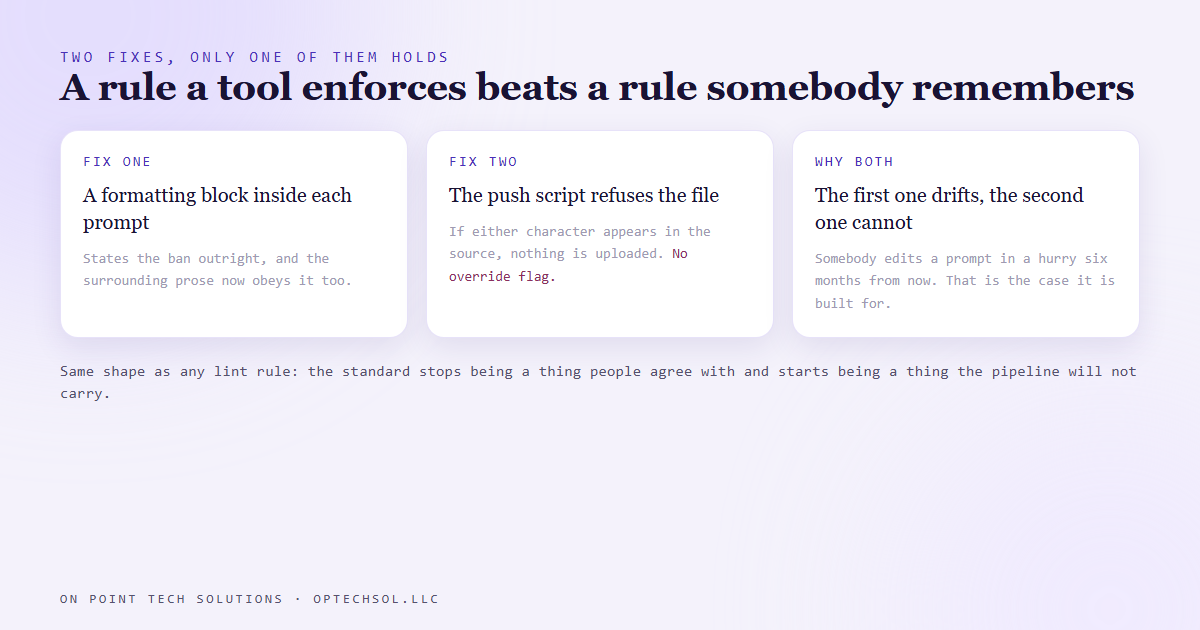
This is the same idea as a linter in software. The standard stops being something people agree with in principle and becomes something the pipeline will not carry. You do not have to be disciplined. You have to be unable to do the wrong thing quietly.
The part we would do differently
Honestly, the lesson is not the dash. The dash is trivial. The lesson is that we had a written brand standard and an automated system speaking on our behalf, and no connection between them at all.
That gap is now the thing we look for first. Any rule about how the business sounds should exist in the place the words are actually produced, not only in the document humans read. And any rule that matters should have something mechanical standing behind it, because the alternative is trusting that every future edit is made carefully by somebody who happens to remember.
What this means for your business
If you have an AI answering texts, emails, or a chat widget, it has a voice, and that voice came from somewhere. Probably from whatever was typed into a setup box once and never read again.
Two things worth doing. Pull up the last twenty messages your automation actually sent, and read them the way a customer would. Not to check the facts, to check whether it sounds like you. That reading is the only way this class of problem ever gets caught.
Then go and read the instructions you gave it, and notice that they are a writing sample. If you want short sentences, write the prompt in short sentences. If you want warmth, be warm in it. Demonstrate the thing you are asking for, because the model will follow what you did over what you said.
Your automation is not a neutral pipe. It is a member of staff who learned everything about how your business talks from one document. It is worth making that document a good example.
Want this built properly
We build and tune AI assistants for small businesses so they sound like the owner instead of like software. Want to build this yourself? Join the On Point Tech Academy. It's free, and we build live every Tuesday and Thursday.
The On Point Tech Academy costs nothing and never asks for a card. We build live every Tuesday and Thursday, 12:30 to 1:30 PT.
Join the Academy free ← Back to all Field Notes