Key takeaways
- Since August we've had about a dozen recorded conversations with Bay Area insurance agents and financial advisors, from solo agents to people on large teams.
- Their business runs on relationships. The AI that pays off for them keeps those relationships warm and leaves the advising to the human.
- The advisors moving fastest bring their compliance team in at the start, so every message and tool is cleared before it goes out.
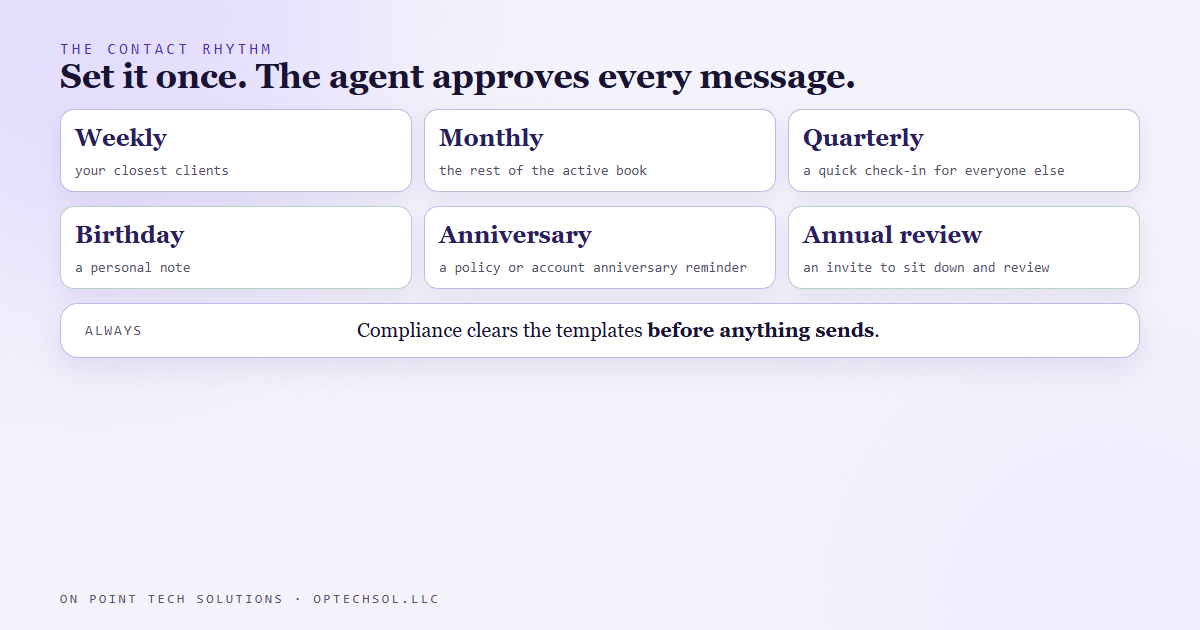
- The easiest first win is putting the contact rhythm they already believe in on a schedule: birthdays, policy anniversaries, annual reviews, quick check-ins.
Insurance and financial planning are trust businesses. Clients stay for decades, and new ones mostly arrive because someone they know vouched for you. So when people ask me how AI fits into this industry, my answer is that it fits around the relationship, not inside the advice.
We build marketing automation in San Jose and around the Bay Area, and this fall a lot of our calls were with people in this world: financial advisors at big firms and independent ones, life and annuity agents, a Medicare agent, a team that does retirement planning. Some were clients, some were networking partners, some were just comparing notes. Here's what we keep hearing, and where AI is already doing real work for them.
What we're hearing from agents and advisors
The first thing almost everyone says is that business comes from people. Chambers of commerce, rotary, networking groups, referrals from happy clients. Thank-you cards and birthday cards in the mail still come up as a referral source, and I love that.
The second thing is compliance. Advisors at larger firms told us any new tool gets vetted by their compliance team before they can touch it, and agents told us marketing to their own client list needs approval too. Nobody we talked to sees that as a reason to skip AI. They see it as the order of operations.
The third is a move toward virtual. More meetings happen on Zoom or over the phone now, and agents who used to sit at kitchen tables want clients to book a video call online without the back and forth.
Five ways AI is already working for them
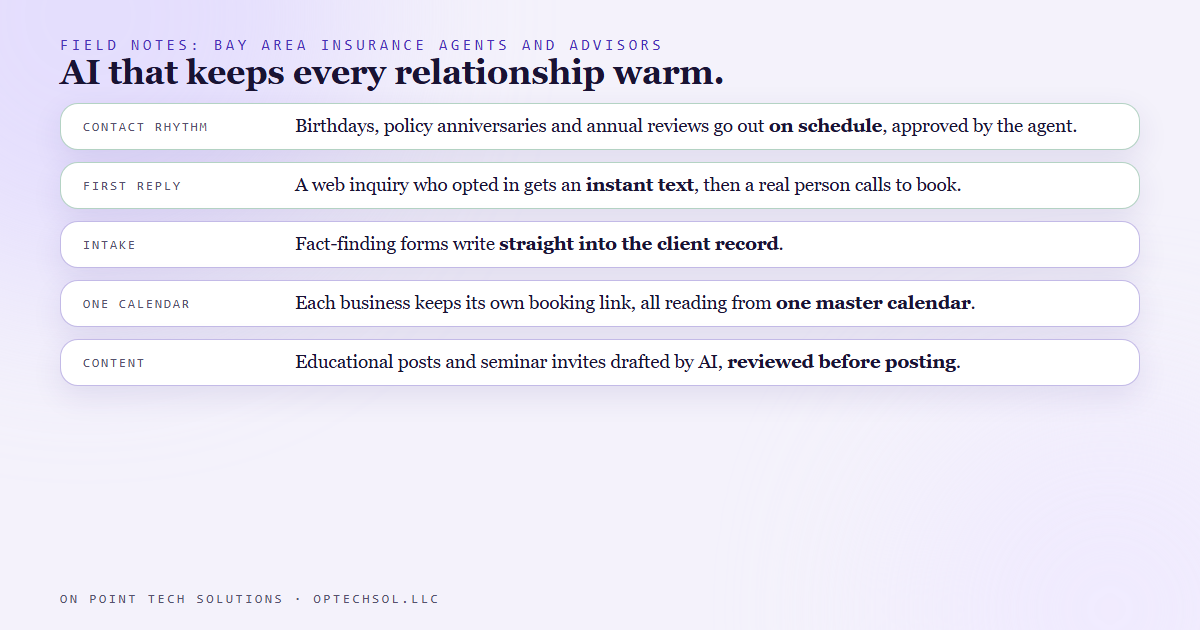
1. The contact rhythm, on a schedule. Good advisors already tier their clients: some hear from them weekly, some monthly, some every couple of months. AI turns that tiering into a schedule. Birthday messages, policy anniversary reminders and annual review invites go out on time, drafted by AI, approved by the agent, and cleared by compliance where the firm requires it. The relationship stays personal. It just stops depending on memory.
2. A fast, friendly first reply. When someone fills out a form on an agent's site and agrees to be contacted, they get a text and an email right away, and a real person calls within a couple of minutes to book a time. In a business this trust-heavy, the agents we talk to want a human on that first call. The automation makes sure the human gets there before the prospect moves on.
3. Intake forms that fill in the file. Fact-finding used to mean a long packet. The intake forms we've built for agents this fall write the answers straight into the client's record instead of a separate note, and the layout we keep coming back to is wide, with fields side by side, so it's easier to fill in. The agent opens the file and the details are already there.
4. One calendar for the whole week. Plenty of agents run more than one line of business. The clean setup keeps each business in its own account with its own booking link, and every calendar reads from one master calendar so nobody gets double booked.
5. First drafts of content. Some agents already use an AI assistant to draft LinkedIn posts, brand pages and seminar invites. The ones getting the most out of it keep the content educational, put it through review, and post it under their own name and face.
What the leaders have in common
They own their accounts. Their page, their ad account, their contact list and their branding sit in accounts they control. If a vendor relationship ends, the marketing doesn't start over.
Compliance is in the room early. They ask what's pre-approved before they build, and they pick tools their firm can sign off on. That turns compliance from a wall into a checklist.
The human does the advising. AI drafts, schedules, sorts and reminds. Recommendations about a client's money or coverage come from the licensed professional, every time.
They nurture for months, not days. Retirement and protection decisions take time. The agents who run seminars and events build a follow-up path for each one, with an invite, a reminder, a thank-you and a check-in a few weeks later, so interest carries through a long decision.
Your first week with AI as an agent or advisor
- Day 1: Write down your contact rhythm. Who hears from you weekly, monthly, quarterly, and on which dates.
- Day 2: Ask your compliance team what's already approved: message templates, tools, disclosures. Start there.
- Day 3: Set birthday and anniversary reminders for your book. Let AI draft the notes, then make them sound like you.
- Day 4: Turn on an instant reply for web inquiries from people who opted in, with your own call to follow.
- Day 5: Draft one educational LinkedIn post with AI, edit it in your voice, and send it through review.
Why this matters for marketing automation in San Jose
Bay Area clients have options, and they tend to pick the advisor who remembers them. An agent with a full book can't hand-write every check-in, but a system can make sure every one of them hears from the agent at the right time. That's the kind of marketing automation San Jose agents and advisors keep asking us about: more time with clients and fewer dates slipping through the cracks.
Want to learn how to set this up?
Join the On Point Tech Academy at optechsol.llc/academy. It's free, and we build live every Tuesday and Thursday.
The On Point Tech Academy costs nothing and never asks for a card. We build live every Tuesday and Thursday, 12:30 to 1:30 PT.
Join the Academy free ← Back to all Field Notes