Key takeaways
- We've spent this fall building listing pages and follow-up systems with Bay Area real estate agents, and talking through AI with agents on recorded calls.
- The agents getting the most from AI use it to follow up like a full team: every open house visitor, every missed call, every past client on their home anniversary.
- Most agents already use a chat AI to draft emails and listing copy. The bigger win is connecting it to a database they own.
- The consensus among agents we talked to: build the follow-up system before you spend on ads.
Real estate might be the industry where AI fits most naturally. The job is mostly conversations, and most of those conversations are follow-ups that get dropped because one agent can only text so many people in a day.
We work with real estate agents on Go High Level in the Bay Area, and this fall that meant building listing pages, lead capture and follow-up for agents, plus long recorded calls with agents weighing their options. Here's what we're seeing about how agents are actually using AI right now, and what the ones doing it well have in common.
What we're hearing from Bay Area agents
Almost every agent we talk to already uses a chat AI for something. One drafts open house emails in it before handing them to the team. Another has a paid plan and is just starting to explore the features that can move data between apps. That's typical. AI is already on the desk. It just isn't connected to anything yet.
The second thing agents bring up is ownership. Many work out of a CRM that came with their brokerage or team, and some of the lead tools they use only work with leads the team hands them. That's fine for team leads. But their own sphere, the friends, past clients and neighbors who will send them business for the next twenty years, needs a home that goes with them if they ever move brokerages.
The third thing surprised me. One agent told us about a group of agents comparing notes on ads versus follow-up, and the takeaway was clear: the ones with a follow-up system behind their ads did better. That agent came away with a plan of system first, then the website, then ads. I couldn't agree more.
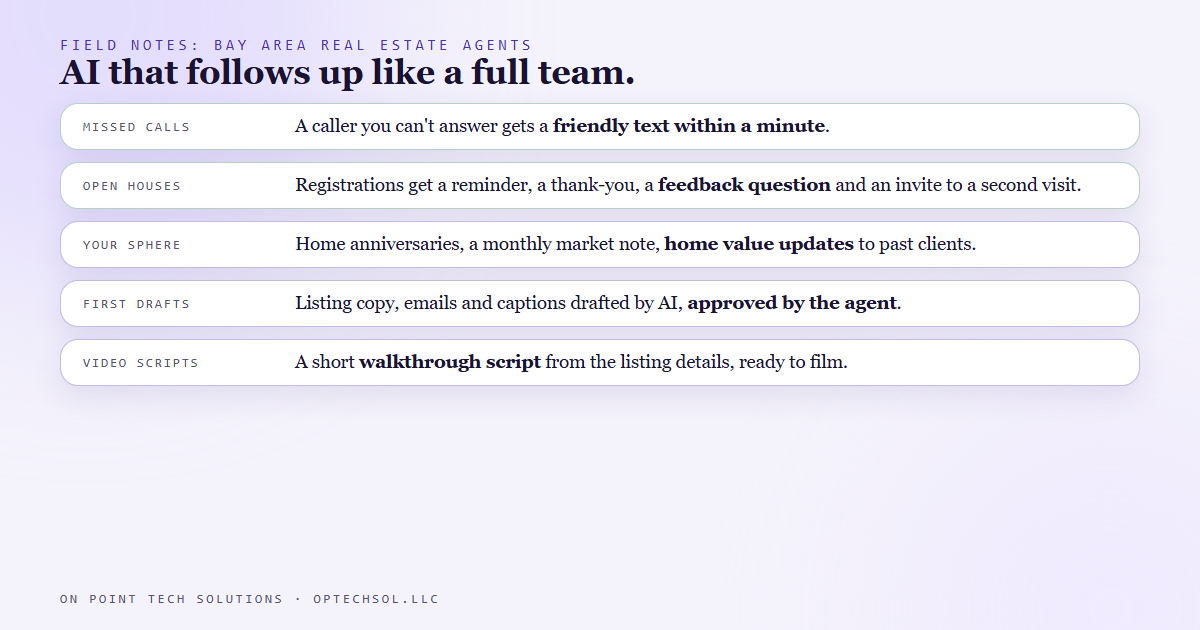
Five ways AI is already working for agents
1. Missed call text back. You're in a showing and the phone rings. Instead of voicemail, the caller gets a friendly text within a minute saying you'll call back and asking what they're looking for. Most of the time that one text keeps the lead from calling the next agent on the list.
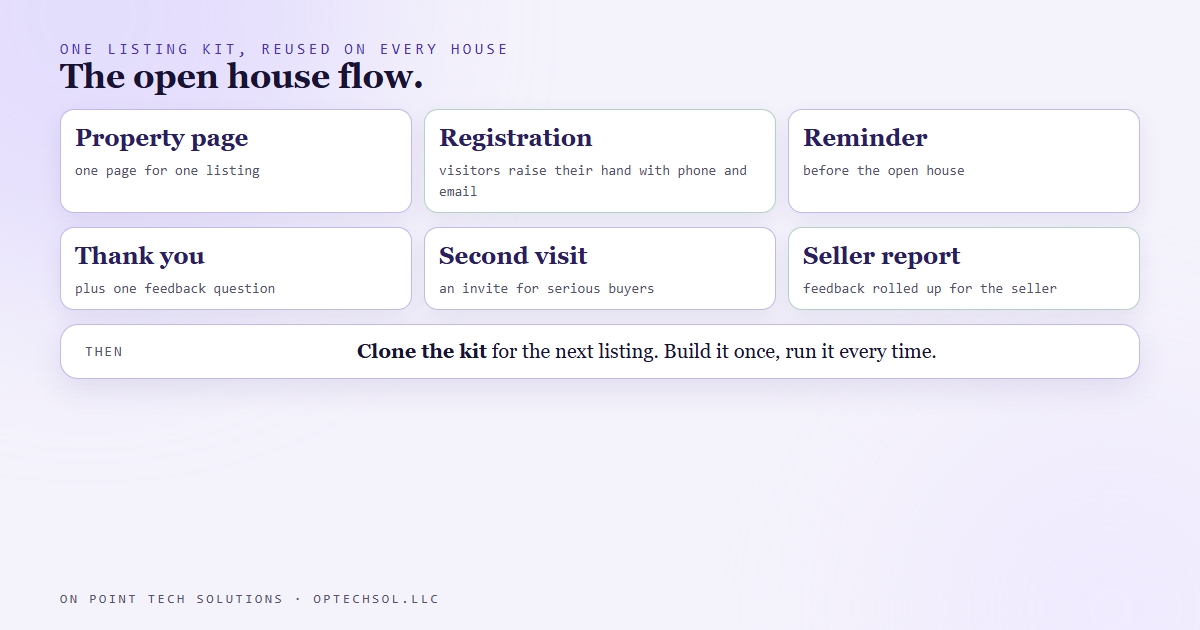
2. Open house follow-up that runs itself. The best listing setup we've built works like this: ads point to a page for that one property, visitors register with a phone and email, they get a reminder before the open house, a thank-you and a feedback question after, and an invite to a second, smaller event for serious buyers. The feedback goes straight into a report for the seller. Everyone in that flow raised their hand and gave their contact info, so you're following up with permission.
3. Sphere nurture on autopilot. Home anniversary messages. A monthly market report. A home value update sent to past clients. These are the touches every agent knows they should do and almost nobody does by hand. AI drafts them, the agent approves them, the system sends them on schedule.
4. First drafts of everything. Listing descriptions, open house emails, social captions, just-sold posts. Agents are already doing this in chat AI. The win is having those drafts land inside the same system that sends them, so nothing gets copied and pasted three times.
5. Listing walkthrough videos. This one's newer. We've been testing an AI idea that writes a short walkthrough script from the listing details, so an agent can film a clean video tour of the home fast. It's early, and it's one of the ideas we're most excited about for agents.
What the leaders have in common
They own their database. Their sphere lives in a system they control, with their own branding and their own texting number, separate from whatever the brokerage provides.
They build one listing kit and reuse it. One agent we work with asked for a standard package for every listing: a property page, lead capture, follow-up and ads, ready to clone for the next house. That's the right instinct. Build it once, run it on every listing.
They plan for slow months. No listing this month doesn't mean marketing stops. The agents doing well shift to seller-focused content, just-sold stories and video testimonials, with the seller's permission, so the pipeline keeps filling.
They put their own face on it. One agent told us they want their face front and center so people recognize them before they ever meet. AI can help with scripts, captions and editing. The face stays real.
Your first week with AI as an agent
- Day 1: Export your sphere from wherever it lives today. Your phone, your email, the brokerage CRM if you can. Get it in one list you own.
- Day 2: Turn on a missed call text back. Write it in your own voice.
- Day 3: Write a home anniversary message and a short monthly market note. Let AI draft them, then make them sound like you.
- Day 4: Map your open house follow-up: reminder, thank-you, feedback question, next step.
- Day 5: Pick one listing and build its page. That becomes your template for the next one.
Why this matters for Bay Area agents using Go High Level
Bay Area buyers and sellers do their homework, and they talk to more than one agent. The agent who answers first, follows up kindly and stays in touch for years tends to win the deal and the referral after it. That used to take an assistant or a whole team. Now a solo agent can run that level of follow-up with the right setup.
For Go High Level in the Bay Area, the formula we keep landing on is simple: own your database, connect your AI to it, and let the system handle the follow-up while you handle the people.
Want to learn how to set this up?
Join the On Point Tech Academy at optechsol.llc/academy. It's free, and we build live every Tuesday and Thursday.
The On Point Tech Academy costs nothing and never asks for a card. We build live every Tuesday and Thursday, 12:30 to 1:30 PT.
Join the Academy free ← Back to all Field Notes