Key takeaways
- Every message we send goes out through the CRM, so the whole conversation lives on the contact's record instead of in somebody's personal inbox.
- A personal referral text went out from the account's default line, which is a toll free number labelled for calendars and invoices.
- Nothing errored. The message arrived. It just arrived looking like a robocall from a company the recipient had never dealt with.
- Personal messages now name the sending number explicitly. Automated and cold outreach deliberately stay on the shared default.
- The account has two numbers sharing a local prefix, so the sending line gets picked by its label, never by its area code.
We have a standing rule here that every outbound email and text goes through the CRM. Not because it is convenient, because it usually is not. It is so that one year from now, anybody looking at a contact can see every conversation that has ever happened with that person in one place. A text sent from a phone is invisible to the business. It happened, and nobody can find it.
The rule works. What we had not thought about was which phone number the CRM would use.
A referral that arrived wearing the wrong face
Michael sent a short personal text passing a referral to somebody he knows through a local business group. Warm, by name, the kind of message that only works because it obviously came from a person.
It went out from the account default. That is a toll free number, and its label in the system says it is for calendars and invoices, because that is the job it was set up for. Appointment reminders. Payment links. The unglamorous automated traffic every business has.
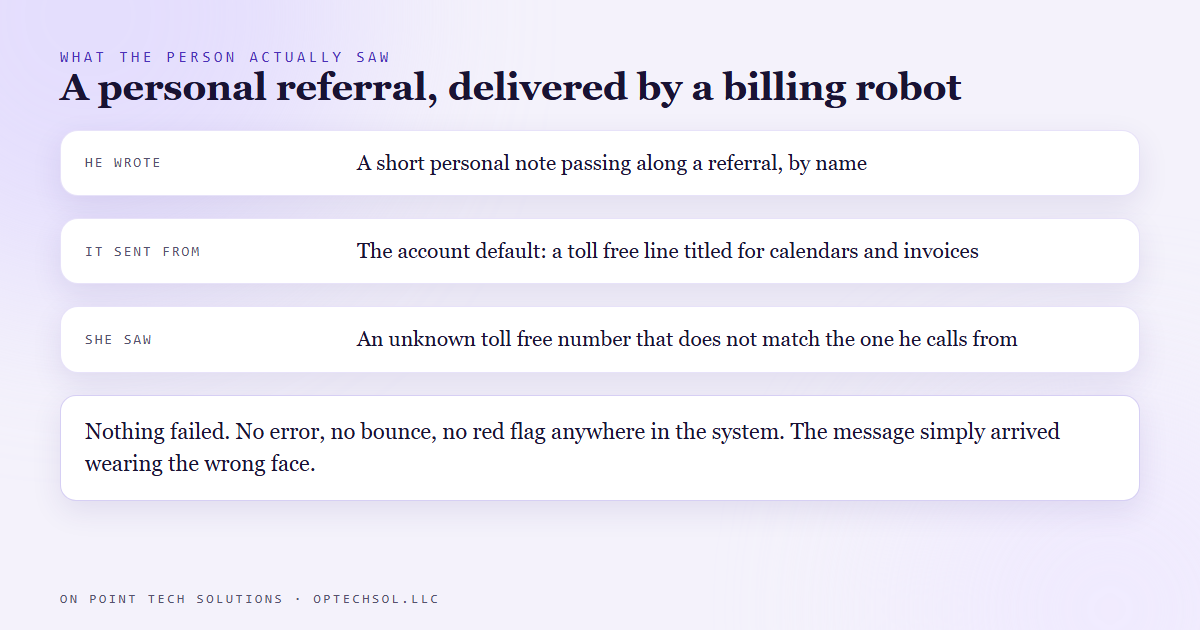
So the message on her phone was a warm personal note from a name she recognised, delivered by an unfamiliar toll free number that did not match the number he calls her from. If she had scrolled up looking for the last time they spoke, there would be nothing there, because the earlier conversation was on his actual line.
Every modern phone is trained to distrust exactly that shape. Toll free prefix, no thread history, unsolicited. Most people delete it without reading past the first line, and a fair number report it. The one thing you never want to do to a referral is make it look like spam.
Why nothing caught it
This is the part that makes it worth writing up rather than just fixing.
Nothing failed. The send returned a success. The message was delivered. It appeared on the contact's timeline exactly as it should. Every signal the system produces said this had gone perfectly, because by every measure the system tracks, it had.
The sending number is not something you can see in the draft. You write the words, you look at the words, the words are fine. The one piece of the message that was wrong is the one piece that is invisible right up until it lands on somebody else's screen.
That is a whole category of bug worth naming: the part of the output you never look at because you are looking at the part you wrote. Email has the same shape. Everybody proofreads the body and nobody checks the reply to address.
The rule we wrote afterwards
The fix has two halves, and the second half is the one people skip.
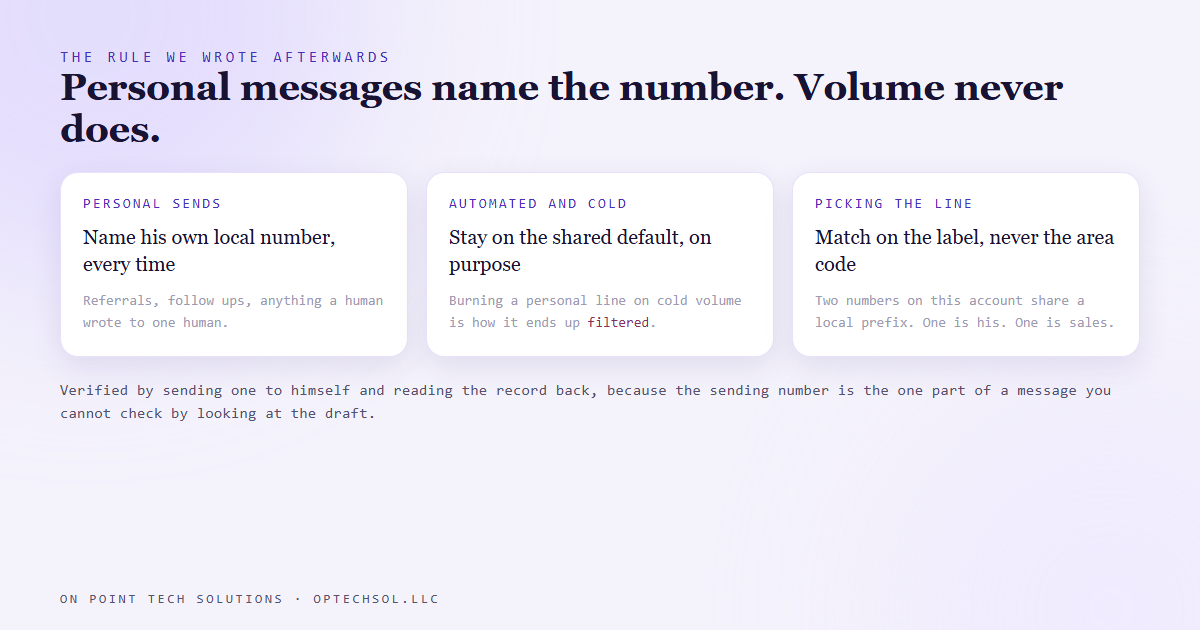
The first half is that any message a human wrote to one other human names the sending number explicitly. Referrals, follow ups after a meeting, anything personal. It comes from his own local line, the same number he calls from, so the text sits in the same thread as the last conversation they had.
The second half is that automated and cold outreach stays on the shared default on purpose. That is not laziness. Carriers filter aggressively, and reputation attaches to a number. Push a few hundred cold messages a week through your personal line and it will eventually stop being reliably delivered, including to the people you actually know. Once that happens there is no fix, only a new number and a new reputation to build.
So the split is deliberate. Personal volume, personal line. Bulk volume, the line that exists to absorb it.
Pick the line by its label
One practical trap sits underneath all of this. Our account has two numbers with the same local prefix. One is Michael's. The other is the sales line. They look near identical in a list.
So the sending number gets chosen by its label in the system, never by matching an area code. Area codes are not identity. If you have more than one number on an account, name them in a way that survives somebody reading the list quickly at four in the afternoon, and match on the name.
We verified the fix the only way it can honestly be verified: by sending a real message and reading back what the record said it sent from. A draft cannot tell you this. A preview cannot tell you this. Only a real send can.
What this means for your business
If you use any kind of business phone system, there is a good chance you do not know which number your messages leave from. Most systems have a default, most people never set it, and the default is usually whichever number was added first.
Three things worth doing this week. Send yourself a text from your business system and look at what number it arrives from. Check that the number matches the one you actually call people from, because a mismatch quietly breaks every thread. And if you have more than one line, decide which one carries personal messages and which one carries volume, then write it down somewhere the next person will find it.
The bigger point is that automation is not only about whether a message goes out. It is about what the message looks like when it lands. The content can be perfect and the delivery can still undo it. A referral is the most valuable message a small business ever sends, and it is worth ten minutes to make sure it does not show up looking like it came from a machine.
Want this built properly
We set up CRM and phone systems for small businesses so the routing is decided once and then holds, instead of being rediscovered after an awkward message. Want to build this yourself? Join the On Point Tech Academy. It's free, and we build live every Tuesday and Thursday.
The On Point Tech Academy costs nothing and never asks for a card. We build live every Tuesday and Thursday, 12:30 to 1:30 PT.
Join the Academy free ← Back to all Field Notes