Key takeaways
- Generating a fresh AI clip for every post does not survive a real posting schedule. The maths kills it in the first week.
- So a clip is treated as capital. Generate it once, tag it by the story beat it serves, and pull it off the shelf forever at no extra cost.
- Eleven clips have cost about a hundred and sixty credits in total and have been used sixty three times so far. That ratio is the whole idea.
- The picker is least recently used, by beat, so nothing gets worn out and nothing sits unused.
- Read the live balance before you spend. The document that recorded the balance was wrong by a factor of four.
The most distinctive thing our brand has is an animated version of me. Stylised, not photoreal, cut into short form video as a two or three second punch. It looks expensive and it is the thing people remember.
It is also the thing most likely to quietly stop existing, and the reason is arithmetic.
The maths that kills per post generation
We post eight or nine times a day. Seventeen of the twenty seven weekly video slots are supposed to carry one of these punches.
Generate one new five second clip per post, on the cheapest tier, and that is roughly a hundred and twelve credits a week. The balance when this was designed was a hundred and fifteen.
So the lane would have looked incredible for four days and then produced nothing at all, silently, with no error anywhere. That failure mode is worse than never building it, because by day five everybody has stopped checking and the schedule just quietly gets thinner.
A clip is capital, not a cost per post
The reframe is small and it changes everything. A generated clip is not an expense attached to one post. It is an asset that gets paid for once and then earns forever.
So every clip goes into a bank with a manifest. The manifest records what the clip shows, which visual lane it belongs to, how much it cost to make, how many times it has been used, when it was last used, and which post used it. The video files themselves sit outside the repository. The manifest is what gets tracked.
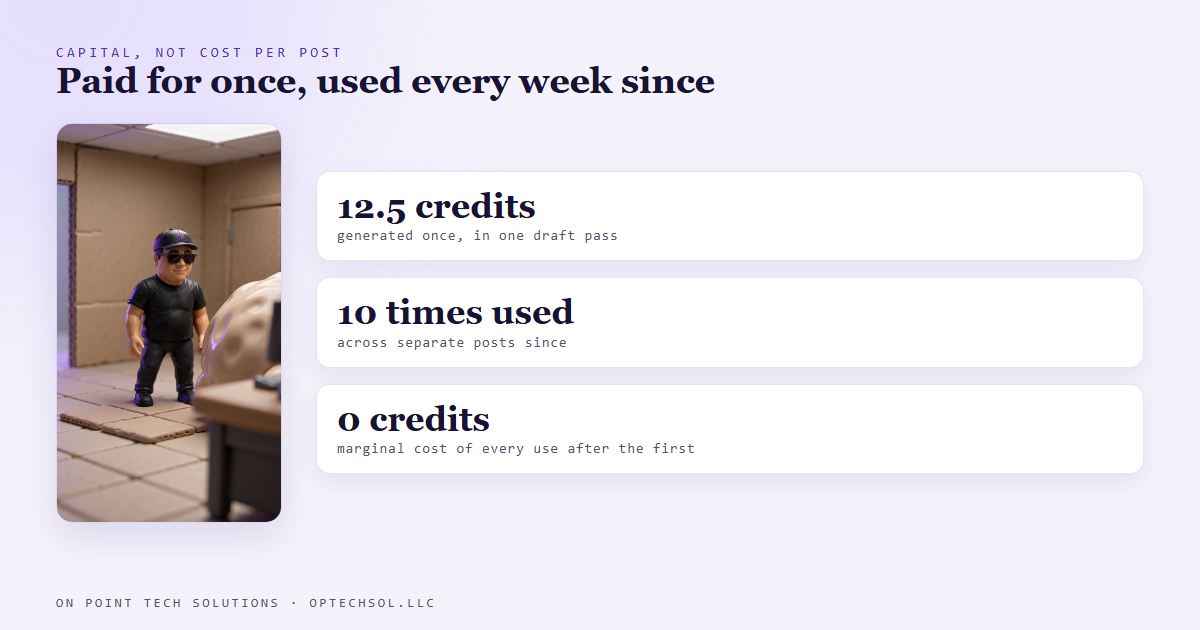
Right now the bank holds eleven clips. Total spend to build it, about a hundred and fifty seven credits. Total uses so far, sixty three. Every one of those sixty three uses after the first was free.
This is the same pattern the music already used. There is a picker that chooses a background track from a small library, least recently used, so nothing repeats too soon. The character bank uses the identical contract on purpose. Two systems that behave the same way are one thing to learn instead of two.
Tagged by beat, because that is what the edit actually asks for
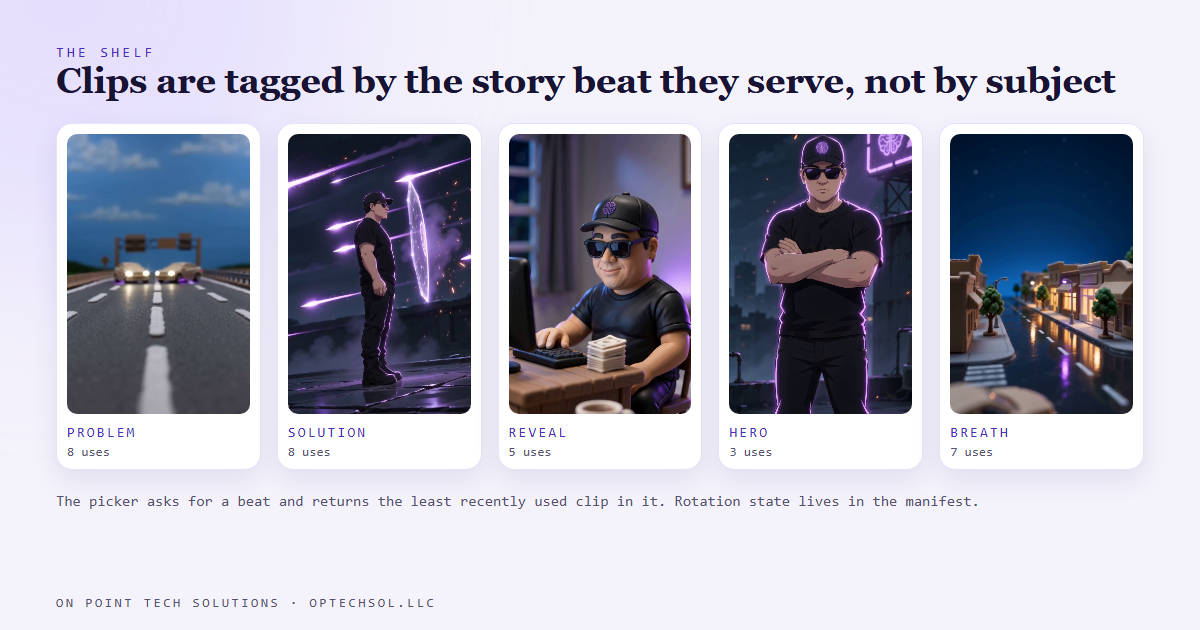
Clips are not tagged by subject. They are tagged by the moment in the story they serve.
There is a beat for the problem, which is what you cut to when the caption names the pain. One for the solution, the system doing the work. One for the reveal, the payoff landing. One for hero, which is straight to camera and deadpan, for cold opens and closers. One for transition, which you cut on and never hold. And one called breath, which has no character in it at all. A miniature street, an empty desk. A moment of quiet between two ideas.
Tagging that way means the editor asks the shelf a useful question. Not give me a clip, but give me a problem beat that has not been used lately. There are two modes. One prints the whole shelf with usage and dates so a human can pick with judgement. The other picks the least recently used clip in that beat automatically, which is what the unattended nightly build uses when nobody is reading a table.
The rule that keeps it honest
These clips stay two to three second punches inside a longer video. They never carry a whole post. A four second clip reused across ten posts over two months is invisible. That same clip carrying an entire thirty second video is very visible, and by the third time somebody has noticed.
Reuse works because the clip is furniture, not the subject. Break that rule and the bank stops being clever and starts looking cheap.
There is also a hard floor. Spending never goes below a reserve that belongs to the daily voiceovers, because those are load bearing for the entire content system and a fun clip is not. Drafts get made on the cheap tier. Only a clip that has earned it gets re-run at higher quality.
The mistake worth stealing
The budget note in the manifest says something blunt. A project document recorded the balance as four hundred and sixty seven credits. The real balance, checked live a few hours later, was one hundred and fifteen. Roughly three hundred and fifty had gone on test generations the same day and nobody had written it down.
So the rule is now written into the file itself. Read the live balance, never read the document for it.
That rule earned itself again while this post was being built. The balance came back at three credits, far under the floor, so nothing new was generated for this article at all. The pictures here are frames pulled straight out of clips the bank already owns. The system did exactly what it was designed to do, which is degrade to free rather than fail.
What this means for Go High Level Bay Area businesses
Most small businesses now have at least one tool that charges per use. Credits, generations, minutes, lookups. The pattern here transfers directly.
- Work out the weekly cost at your real volume, not your demo volume. Anything that looks fine for one post and impossible for sixty is not a tool you can build a schedule on.
- Turn repeated spend into an asset you own. If you are paying to generate something similar over and over, generate a small set once and reuse it. That applies to images, intros, templates and stock answers.
- Check balances from the source, not from your notes. Every metered tool we use has an endpoint or a page that reports the truth. A number in a document is a memory of the truth.
The honest lesson is that the interesting decision was not artistic. It was accounting. Deciding a clip is capital rather than a cost is what turned an expensive gimmick into something that runs every night for free.
If you are paying per use for something you could own once, that is a conversation worth having. Want to build this yourself? Join the On Point Tech Academy. It's free, and we build live every Tuesday and Thursday.
The On Point Tech Academy costs nothing and never asks for a card. We build live every Tuesday and Thursday, 12:30 to 1:30 PT.
Join the Academy free ← Back to all Field Notes