
Key takeaways
- Our news board does not rank by how recent a story is or by which outlet we like. It counts how many independent newsrooms are carrying the same thing.
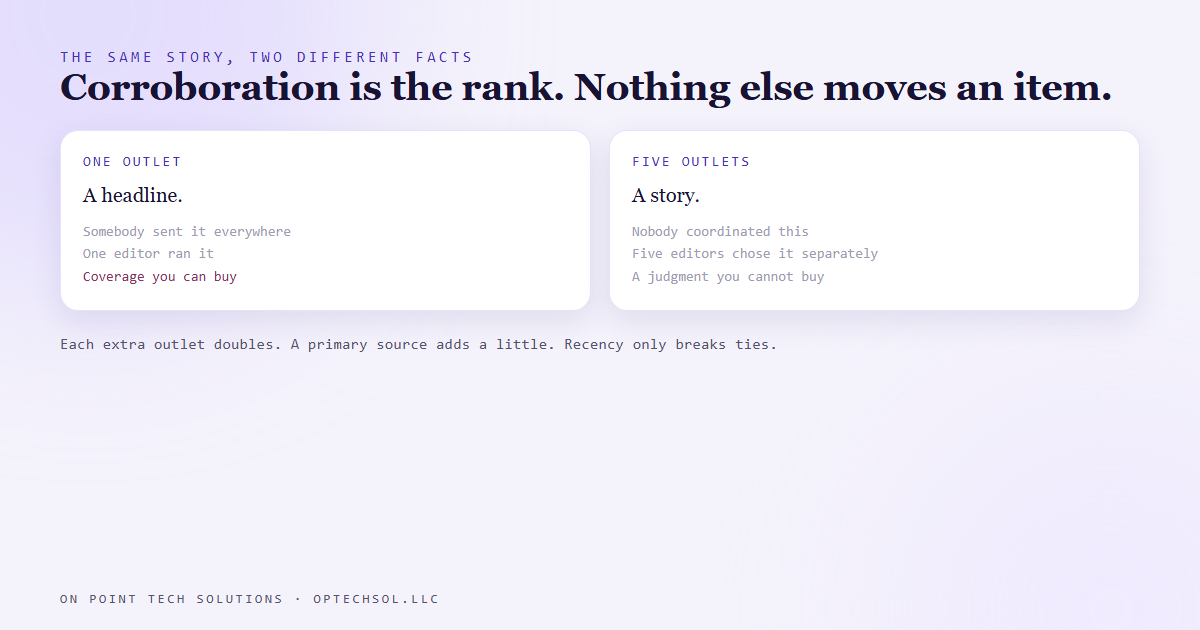
- One outlet is a headline. Five is a story. That count is the only free signal for whether something is real or somebody's announcement.
- Outlets are counted by publisher, not by feed. One newsroom running two feeds read as two independent sources and inflated every story it touched.
- Relevance to what we sell may flag a story, never move it up the list. The moment relevance can rerank, you are reading your own preferences back.
- One source we care about publishes no feed at any address, so it is scraped, has no dates, and needed two guards to stop its backlog flooding the board on day one.
We publish a lot, and the hardest part of publishing is not the writing. It is deciding what is worth writing about. Spend an hour scrolling and you cover whatever you saw first, which is usually whatever somebody paid to put in front of you.
So we built a board that answers the question mechanically. It reads eighteen sources and ranks them, and the rule is one line long: how many separate newsrooms are running this same story right now.
Why corroboration is the signal
A single outlet covering something tells you almost nothing. Every company sends its announcement to every publication and someone always runs it. That is a press release with a byline on it.
Five unrelated newsrooms covering the same thing on the same morning is different. Nobody coordinated that. Five editors independently decided it mattered, and that is a judgment you cannot buy at scale. So the count is the rank. Each extra outlet is worth double anything else, a primary source publishing its own announcement adds a little because it is at least not a rumour, and recency only breaks ties.
The board is free. Eighteen feeds, no keys, nothing metered. It refreshes when you open it rather than on a schedule, because with nothing to prepare overnight there is nothing for a scheduled job to do.
Three counting mistakes, all of them ours
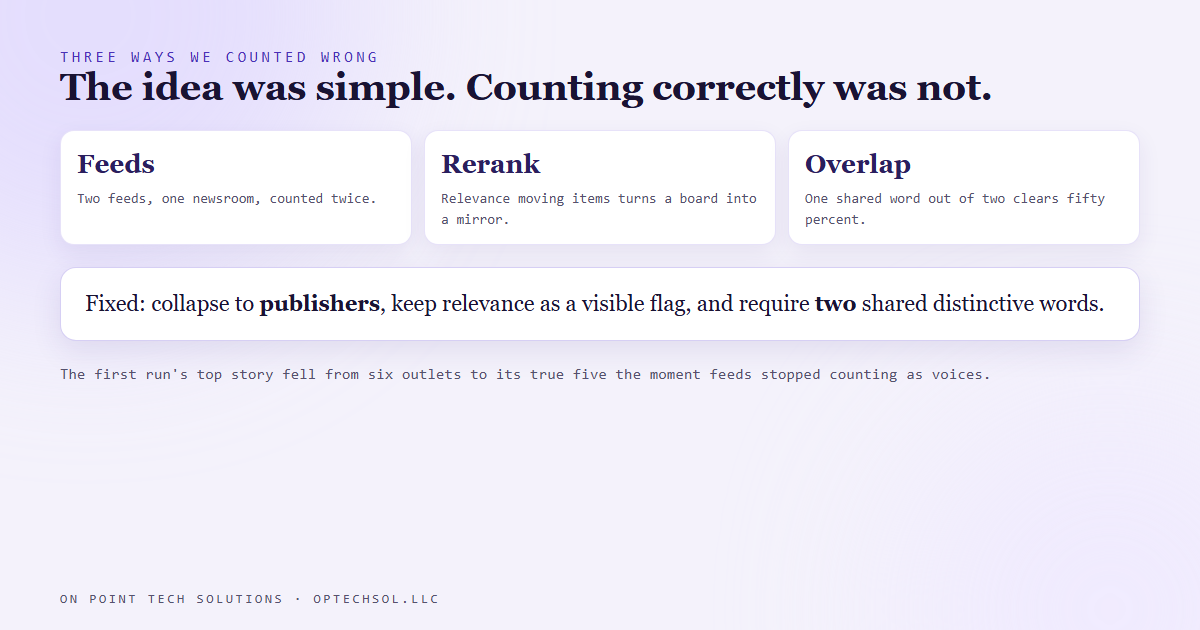
The idea is simple. Counting correctly was not.
The first version counted feeds. One major technology publication runs a general feed and a dedicated one for its artificial intelligence coverage, and the same articles appear in both, so every one of their stories arrived pre-corroborated by itself. On the first run the top item claimed six outlets and had five. The count now collapses to publishers before it scores anything, and a newsroom with four feeds is one voice.
The second was letting relevance move things. We do care more about news touching what we sell than about a policy story with no action in it for a small agency, and the instinct is to weight for that. But a board which promotes what you already care about becomes a mirror. So relevance is a visible flag and it never changes the order. It reads headlines only, because when it read summaries too a pricing flag fired on an article asking why one gadget costs more than another.
The third was grouping. Two stories are the same story if their headlines share distinctive words, which sounds fine until you notice how short headlines are. A rule that merged anything with half its words in common put two entirely different products from the same company into one cluster, because one shared word out of two clears fifty percent. It also merged a review of a tiny e-reader with an essay about readers revolting. Two shared distinctive words are now required always, and the proportional rule only applies when both headlines are long enough for a proportion to mean anything.
The source with no feed
One of the labs whose announcements matter most to us does not publish a feed. We tried four addresses a feed conventionally lives at and every one returned nothing. Its news index does render article links in the page itself, so that source is read straight from the page and titled from the link.
Which creates a real problem: there is no publication date anywhere on that page. All we can honestly record is when we first saw a link, and that is a different fact from when it was published.
The first time it ran, everything on that page was new to us, so an announcement from two months earlier arrived as the morning's top story. On a first run the whole undated backlog is now stamped as old, deliberately, so only genuinely new links surface afterwards.
The second version of that guard failed more subtly. It only remembered links that survived the age filter, so the ones it had just marked old were forgotten immediately and came back as new on the next scan. Measured, it kept three of eleven. Every link is now written down the moment it is seen, before any filter can drop it, and undated ones are remembered for a year.
On the card those items say first seen rather than posted, so nobody reads the timestamp as a publish time.
How we knew any of it worked
Absence is not proof. A scan reporting no new items looks identical whether it is working perfectly or reading nothing at all, so we tested it the other way round: delete one remembered link and run it again. Exactly that one comes back, and nothing else does. That is the difference between believing a system works and having watched it work.
What this means for your business
You probably do not need a news board. You almost certainly have a list you rank by the wrong thing.
Most businesses rank follow-ups by recency, because that is what the software shows first. That is as arbitrary as ranking news by whichever site loaded fastest. The better question is what independent evidence exists that this one is real: they answered, they booked, they came back to the site, somebody else at the same company enquired too. Count those, sort by the count, and your day organises itself.
The other transferable piece is the flag. Keep what you personally care about visible without letting it reorder the list. For a marketing automation San Jose operation, that is the difference between a system that helps you decide and one that agrees with you.
Want this built for you
We build the systems that decide what deserves attention, and the websites and CRM automation behind them. Want to build this yourself? Join the On Point Tech Academy. It's free, and we build live every Tuesday and Thursday.
The On Point Tech Academy costs nothing and never asks for a card. We build live every Tuesday and Thursday, 12:30 to 1:30 PT.
Join the Academy free ← Back to all Field Notes