The Local AI Guy: one story and one new thing to learn, every day, from Los Gatos.
At a BNI one-to-one this month, I sat with a wellness business owner who had just gotten a brand new website. The owner loved it, and was really happy with the designer. And it did look great.
Then came the question of how I fit in, since there are already web designers in our group.
And I said the thing I have been saying a lot lately. Everyone has a website now. What most people don't have is a smart website.
The front of the house and the back of the house
Think about a restaurant. The dining room is what you see. The lighting, the menu, the chairs. That's your website design, and it matters. But the meal comes out of the kitchen. Nobody sees the kitchen, and it's the whole reason you come back.
A smart website is a website with a kitchen. It's not about the front end anymore. It's about the back end, and what the journey looks like for the person who just reached out. When a lead comes in, what do they go through? What happens to them in the next hour, the next day, before you ever talk?
On a lot of websites, the honest answer is nothing. The form goes to an inbox, and the lead sits in the dining room waiting for a waiter who has not seen them yet.
How to build the kitchen
Here's how I set up the back of the house for a business like that one, in GoHighLevel. GHL is the CRM we use, the one place where every lead and every message lives. The steps run inside a workflow, which is GHL's word for a set of steps that happen on their own.
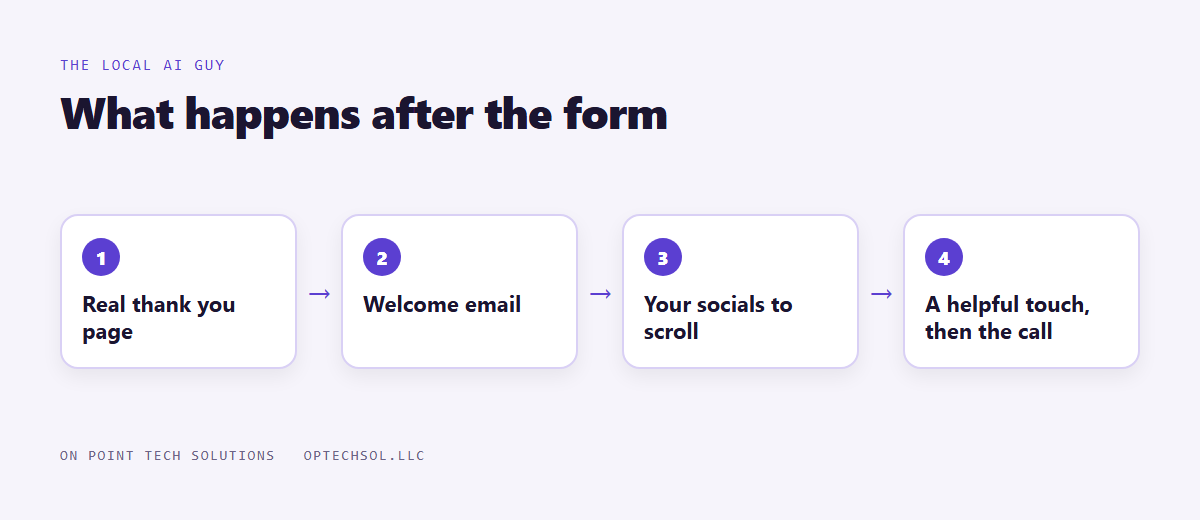
Start with the thank you. The moment someone submits the form, send them to a real thank you page, not a tiny line of gray text. Tell them what happens next and when they will hear from you. People relax when they know what's coming.
Then send a welcome email from the workflow. Use the Form Submitted trigger so it fires on its own. Keep it warm and short: who you're, what you do, and why people come to you.
Next, give them somewhere to look around. Put your Facebook and Instagram links in that email. This is the part people skip, and it's the part I like most. While they wait for you, they scroll your posts, they see your face, they see real work and real clients. You're building trust while you're busy with someone else.
Add a helpful touch or two after that. A day later, send something useful. A short tip, a video, an answer to the question everybody asks before they book. With their permission, a quick text works too.
Last, make the call easy. Have the workflow create a task for you or your team to reach out, so nobody falls through the cracks. When you do call, they're not meeting you cold. They already know your brand.
Design and systems are two different skills
I want to be clear about one thing, because I said it in that meeting too. There will always be website work, and good design is always going to matter. It still takes real skill to come up with a layout that actually turns visitors into customers. I was happy to hear they found someone great.
The kitchen is a different skill. It's more of a business skill than a web skill. You have to understand how a business actually runs, where its touch points are, and how all of it works together so the customer has one smooth experience. That's the part I get to help with, and it works right alongside the designer.
Back to the new website
So picture that beautiful new site with a kitchen behind it. Someone finds her, fills out the form, and immediately gets a warm thank you. An email shows up with the owner's story and Instagram. They scroll for a few minutes and like what they see. The next day they get a helpful note. By the time the owner calls, it doesn't feel like a sales call. It feels like a conversation with someone they already know.
Same website. Same pretty dining room. Now the meal actually comes out.
Why this matters for South Bay businesses
In the South Bay, a lot of small businesses have invested in a good looking site and are wondering why it's quiet. Usually the design is fine. What's missing is the back end. Marketing automation in San Jose and the rest of the Bay Area doesn't have to be complicated. A few touch points after the form is the difference between a brochure and a website that works for you.
A pretty website gets the visit. A smart one gets the client.
Want to build this yourself?
I teach this stuff for free. Join the On Point Tech Academy at optechsol.llc/academy and you get the walk-throughs, the templates and a room full of owners figuring it out with you. And if you would rather we just build it for you, that is what we do every day.
See you tomorrow. Michael, The Local AI Guy.
The On Point Tech Academy costs nothing and never asks for a card. We build live every Thursday, 12:30 to 1:30 PT, with whatever AI you use.
Join the Academy free ← Back to all Field Notes